Structured interview notes for engineering hiring
Hire with a system, not a gut feeling.
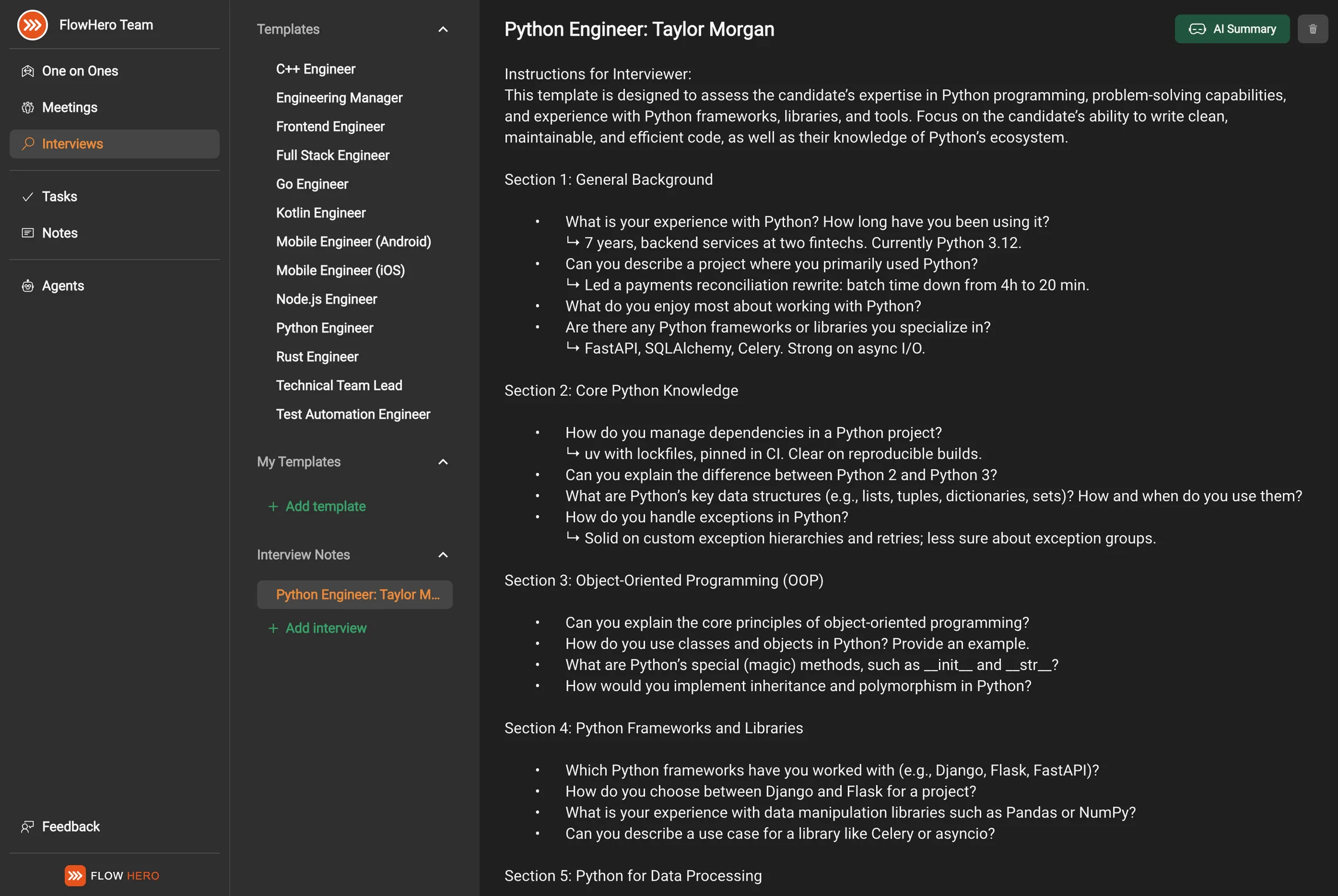
Start every interview from a structured template, write your notes right under each question, and get an AI summary when you're done. Every candidate gets the same fair interview, and every debrief starts from evidence.
Why engineering interviews go wrong
Every interviewer asks different questions
Comparing candidates turns into comparing conversations. One got a system design deep dive, the next one talked about hobbies.
Notes written from memory
A few words in a notebook, typed up hours later. By the debrief, the details that mattered are gone.
Debriefs run on impressions
"I liked them" against "something felt off". Without evidence, the most confident opinion wins.
Write-ups take longer than the interview
Turning raw notes into feedback for the hiring panel eats the rest of the afternoon.
How interviews work in FlowHero
- 01
Pick a template
Use one of 13 built-in templates for engineering roles, or create your own under My Templates.
- 02
Start an interview from it
FlowHero copies the template into a new interview note for the candidate, listed under Interview Notes.
- 03
Take notes under each question
Write as you go, right next to the question each note answers, so nothing needs re-typing afterwards.
- 04
Get an AI summary
One click condenses your notes into a summary you can review, edit and bring to the debrief.
Built for hiring engineers
13 templates for engineering roles
Python, Go, Node.js, Rust, C++, Kotlin, frontend, full stack, iOS, Android, test automation, tech lead and engineering manager. Each one is also free to read on our site.
Your own templates
Write templates for your roles and interview stages once, then start every interview from them so each candidate gets the same questions.
Next to the rest of your work
Interview notes live in the same workspace as your 1:1s, team meetings, tasks and personal notes.
A structured interview checklist
The habits that make interviews fair and comparable, whichever tool you use. Most of them take minutes, not process changes.
- 1.
Decide what you're assessing
Agree on the competencies for the role before the first candidate, not after the last one.
- 2.
Ask everyone the same core questions
Follow-ups can differ; the core questions shouldn't, or the scores can't be compared.
- 3.
Write down evidence, not adjectives
"Explained the GIL and when to use multiprocessing" is useful in a debrief. "Strong" isn't.
- 4.
Score before you talk to others
Rate each competency on your own, straight after the interview, so the first opinion in the room doesn't anchor everyone.
- 5.
Debrief on the evidence
Go competency by competency, and ask for the notes behind every score.
- 6.
Close the loop with the candidate
A quick, specific answer is part of a fair process, whatever the decision.
Our free interview templates include a scorecard and "what to listen for" notes for each section.
Frequently asked questions
What is a structured interview?
An interview where every candidate for a role gets the same core questions and is assessed against the same criteria, usually with a scorecard. Structured interviews are consistently found to predict job performance better than unstructured conversations, and they're fairer to candidates.
Can I use my own interview questions?
Yes. Create your own templates under My Templates, for example by pasting one of our free templates and adapting it to your role and stage, then start each interview from it.
How does the AI summary work?
When you click AI Summary, the notes from that interview are sent to Claude, Anthropic's AI model, which returns a plain-text summary for you to review. It works from your notes only, so the better the notes, the better the summary. We don't use your content to train AI models.
Can other interviewers see my notes?
No. Interview notes live in your account. Share what you choose with the hiring panel or your applicant tracking system, for example by pasting in your notes or the summary.
Is FlowHero free?
You can start free, with no credit card required. Interviews, One on Ones, meetings, tasks, notes and AI agents are all in the same workspace.
Ready to lead with more clarity and confidence?
Start free. No credit card required.
Powered by Claude · Built for Engineering Leaders · hello@flowhero.ai