How to run it in 60 minutes
- 0–5 minIntroductions, the team and how the interview will run
- 5–15 minBackground and leadership approach (sections 1–2)
- 15–35 minThe three scenarios (section 10); ask how they handled something similar in real life
- 35–50 minTwo sections that matter for this team, e.g. performance (8) and stakeholders (5)
- 50–60 minCandidate's questions (section 12); write up your scores right after
The questions
01General background
- Can you tell us about your journey into engineering management?
- What motivated you to transition into an engineering management role?
- How many teams or individuals have you managed in the past?
- Can you share a project where your leadership played a key role in its success?
What to listen for
Why they chose management, beyond "it was the next step". Team sizes and scope. A success where their own part is clear: when they say "we", ask "what did you do?"
02Leadership and team management
- How do you inspire and motivate your team?
- What’s your approach to resolving conflicts among team members?
- How do you identify and address skills gaps within your team?
- How do you manage the balance between team needs and individual career growth?
What to listen for
Concrete habits: regular 1:1s, clear expectations, growth plans. Conflict handled early and directly, with a real example. Skills gaps closed through hiring, pairing and stretch work, not only courses.
03Technical expertise and oversight
- How do you stay updated on technical trends to guide your team effectively?
- How do you ensure your team follows best practices in coding, architecture, and testing?
- Can you share a time when you contributed directly to solving a technical challenge?
- How do you strike the right balance between technical involvement and delegation?
What to listen for
Enough technical depth to judge trade-offs and earn the team's trust without becoming a bottleneck. Quality kept by systems (reviews, CI, design docs, incident reviews) rather than personal heroics.
04Project and program management
- How do you prioritize tasks and allocate resources for your team?
- Can you describe your experience with Agile or other methodologies in managing projects?
- How do you handle projects that go off track in terms of timeline or scope?
- What’s your approach to managing dependencies across teams or departments?
What to listen for
Priorities tied to impact, with the trade-offs made visible. When a project slips: early warning signs, cutting scope or moving dates openly, then fixing the cause. Dependencies handled by talking to the other team, not only filing tickets.
05Communication and stakeholder management
- How do you ensure clear communication between your team and stakeholders?
- Can you share an example of how you’ve managed conflicting priorities from stakeholders?
- How do you handle delivering bad news, such as missed deadlines, to leadership?
- How do you translate technical concepts into business terms for non-technical stakeholders?
What to listen for
Bad news delivered early, with options and a plan. Technical work explained in business terms: risk, cost, time. Saying no to a stakeholder with reasons and an alternative.
06Culture and team dynamics
- How do you foster a culture of collaboration and trust within your team?
- What steps do you take to ensure diversity and inclusion in your team?
- Can you share how you’ve helped improve team morale during challenging times?
- How do you handle situations where team dynamics are negatively impacting productivity?
What to listen for
Trust built through consistency, psychological safety and fair processes. Inclusion shown in practices (how they run meetings, hand out work and support promotions), not statements.
07Recruiting and onboarding
- What’s your approach to hiring top engineering talent?
- How do you evaluate candidates for both technical skills and how they'll work with the team?
- Can you share an onboarding process you’ve implemented to help new hires succeed?
- How do you ensure new hires integrate well into the team?
What to listen for
A structured hiring process: clear criteria, consistent questions, scorecards, debriefs. Looking for what a candidate adds to the team rather than "fit". Onboarding with a buddy, a first-week plan and an early small win.
08Performance and metrics
- What metrics do you use to measure the success of your team?
- How do you track individual performance while maintaining team accountability?
- Can you share how you’ve dealt with underperforming team members?
- How do you recognize and reward high-performing team members?
What to listen for
Team outcomes over activity: delivery, quality, DORA-style metrics used to start conversations, not as targets. Underperformance handled with clear expectations, regular feedback, support and a timely decision.
09Strategic thinking and vision
- How do you align your team’s work with the company’s strategic goals?
- What’s your approach to setting long-term technical direction for your team?
- Can you share an example of how you’ve driven innovation within your team?
- How do you balance short-term deliverables with long-term technical debt management?
What to listen for
Team work linked to company goals, with the "why" explained to the team. Technical debt handled as an explicit, ongoing budget rather than a side project.
10Scenario-based questions
Scenario 1
- Your team is falling behind on a critical project due to unforeseen challenges. How do you handle the situation?
Scenario 2
- You have a high-performing engineer who is unhappy with their role. How do you address this?
Scenario 3
- A major production incident occurs. How do you lead your team through the resolution process?
What to listen for
A clear structure: understand, communicate, decide, follow up. Incident: stabilize first, assign roles, communicate on a cadence, then a blameless review. Unhappy engineer: listen first, then act on growth, scope or recognition.
11Challenges and growth
- What do you find most challenging about being an engineering manager?
- How do you ensure you continue to grow as a leader?
- Can you share feedback you’ve received as a manager and how you acted on it?
- What’s an area of engineering management you’re actively working to improve?
What to listen for
Self-awareness: real feedback they received and what they changed because of it. Vague answers like "I care too much" are a warning sign.
12Closing questions
- What excites you most about this role and our team?
- Do you have any questions about the company, team, or projects?
- Is there anything else you’d like us to know about your leadership style or experience?
What to listen for
Questions about team health, how success is measured and how leadership decides things show they already think like a manager.
Scorecard
Rate each competency from 1 to 4 straight after the interview, before you compare notes with other interviewers, and write down the evidence behind every score.
| Competency | What to assess | Score |
|---|---|---|
| People leadership | 1:1s, feedback, growth, handling conflict | 1–4 |
| Delivery | prioritization, planning, handling slips | 1–4 |
| Technical judgment | trade-offs, quality systems, technical debt | 1–4 |
| Stakeholder communication | clarity, delivering bad news, influence | 1–4 |
| Hiring and team building | structured hiring, onboarding, inclusion | 1–4 |
| Performance management | expectations, underperformance, recognition | 1–4 |
| Strategy | aligning work to goals, long-term direction | 1–4 |
| Self-awareness | learning from feedback, honest reflection | 1–4 |
- 1 · No evidence
- Couldn't answer, or the answer was wrong.
- 2 · Partial
- Knows the concept, but couldn't apply it or needed heavy prompting.
- 3 · Solid
- Correct and applied it to a real example, with minor gaps.
- 4 · Strong
- Clear, correct, discussed trade-offs and went beyond the question.
Run this interview in FlowHero
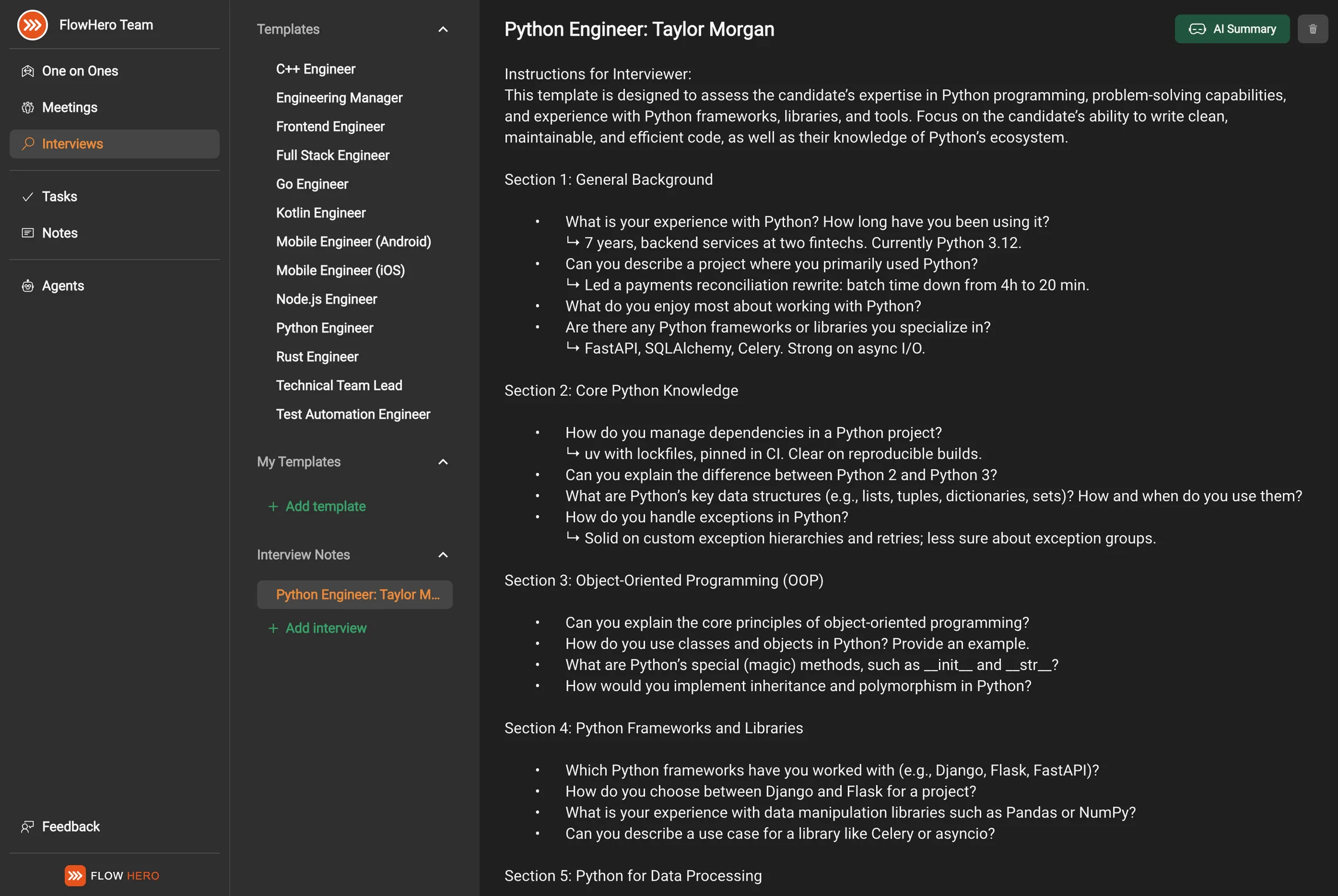
This template is built into FlowHero. Start an interview from it, take notes under each question while you talk, and get an AI summary of your notes to review before the debrief. Start free. No credit card required.
Questions about this template
How is an engineering manager interview different from a tech lead interview?
An engineering manager interview focuses on people: hiring, growth, performance and the organization. A tech lead interview focuses on technical direction and hands-on leadership. Many companies run both kinds of question for managers, weighted toward people.
Should engineering manager candidates do a coding interview?
Usually not a coding round. Assess technical judgment through a system design discussion or a deep dive into past technical decisions instead. If the role is expected to code regularly, add a light hands-on round.
How do I tell real experience from rehearsed answers?
Ask for a specific example and follow up two or three levels: what exactly did you do, what happened next, what would you do differently? Rehearsed answers stay general; real experience has names, numbers and trade-offs.