How to run it in 60 minutes
- 0–5 minIntroductions, the role and how the interview will run
- 5–15 minBackground and backend development (sections 1 and 3)
- 15–40 minExercise: one thin end-to-end slice with follow-ups (section 7)
- 40–52 minDatabase design and system design (sections 4–5), or the candidate's weaker side of the stack
- 52–60 minCandidate's questions (section 10); write up your scores right after
The questions
01General background
- Tell me about your experience working as a Full Stack Engineer.
- Which front-end and back-end technologies are you most comfortable with?
- Can you describe a project where you worked on both the front-end and back-end?
- How do you prioritize tasks when working across the entire stack?
What to listen for
Where they're strongest (most full stack engineers lean one way) and how they move between layers when building one feature.
02Front-end development
- Which frameworks or libraries do you prefer for front-end development (e.g., React, Angular, Vue)? Why?
- How do you ensure responsive design across different devices and screen sizes?
- Can you explain the concept of state management? How have you handled it in past projects?
- What is your approach to optimizing front-end performance?
What to listen for
The same signals as a frontend interview at lighter depth: component structure, state, responsive layout, performance basics.
03Back-end development
- What back-end frameworks or technologies do you use (e.g., Node.js, Django, Ruby on Rails)?
- How do you design and build RESTful APIs?
- Can you explain the difference between SQL and NoSQL databases? When would you use each?
- How do you handle server-side authentication and authorization?
What to listen for
API design: resources, status codes, pagination, validation, versioning. SQL vs NoSQL chosen by data shape and query patterns. Passwords hashed with bcrypt or Argon2, sessions vs tokens explained, authorization checked on the server.
04Database design
- How do you design database schemas for scalable applications?
- Can you describe a challenging database issue you’ve encountered and how you resolved it?
- What is your experience with database optimization (e.g., indexing, query optimization)?
- How do you handle database migrations in a production environment?
What to listen for
Normalization and when to denormalize, indexes matched to query patterns, reading a query plan, and backward-compatible migrations (expand, migrate, contract).
05System design and architecture
- Can you explain the concept of microservices and when you would use them?
- How do you design scalable and maintainable systems?
- What strategies do you use for caching to improve application performance?
- How do you handle real-time data in your applications?
What to listen for
Microservices treated as a trade-off, with a well-structured monolith as a sensible start. Caching layers and how to invalidate them. Real-time via WebSockets or server-sent events, and when polling is fine.
06DevOps and deployment
- What is your experience with CI/CD pipelines?
- How do you monitor and troubleshoot production issues?
- Can you describe a deployment process you’ve set up or managed?
- What is your approach to containerization and orchestration (e.g., Docker, Kubernetes)?
What to listen for
CI/CD with tests and safe rollouts (feature flags, canaries, quick rollbacks). Monitoring with logs, metrics and traces, alerting on what users actually feel.
07Problem-solving exercise
Give one realistic problem and let the candidate talk through it while they build.
Coding challenge (pick one)
- Build a simple web application where users can create, read, update, and delete (CRUD) items, with front-end validation and a back-end API.
- Create a user authentication system with login, logout, and role-based access control, using a front-end and back-end stack.
Follow-up questions
- How would you secure this application against common vulnerabilities (e.g., SQL injection, XSS)?
- How would you scale this application to handle 1 million users?
What to listen for
A thin working slice end to end before polishing. Validation on both client and server. Security: parameterized queries, output encoding, CSRF protection, secrets out of the code. Scaling: stateless servers, the database as the first bottleneck, caching and queues.
08Testing and quality assurance
- How do you test your front-end and back-end code?
- Can you describe your experience with unit testing, integration testing, and end-to-end testing?
- How do you ensure code quality and maintainability in collaborative projects?
- What tools or frameworks do you use for automated testing?
What to listen for
A testing pyramid they really follow: many unit tests, fewer integration tests, a handful of end-to-end tests on critical paths.
09Collaboration and teamwork
- How do you collaborate with designers, product managers, and other engineers?
- Can you describe a situation where you had to resolve a technical disagreement with a teammate?
- How do you mentor junior developers or share knowledge within a team?
What to listen for
Bridging product, design and engineering. Mentoring with concrete examples.
10Closing questions
- What excites you most about being a Full Stack Engineer?
- Are there any tools, frameworks, or technologies you’re currently exploring?
- Do you have any questions for us about the role or the team?
What to listen for
Curiosity about the product and what they'd learn in the role.
Scorecard
Rate each competency from 1 to 4 straight after the interview, before you compare notes with other interviewers, and write down the evidence behind every score.
| Competency | What to assess | Score |
|---|---|---|
| Frontend | components, state, responsive design, performance | 1–4 |
| Backend and APIs | API design, auth, validation | 1–4 |
| Data | schema design, indexing, migrations | 1–4 |
| Architecture | system design, caching, scaling | 1–4 |
| Delivery and operations | CI/CD, monitoring, incidents | 1–4 |
| Problem solving | exercise: scope, correctness, trade-offs | 1–4 |
| Quality and security | testing strategy, common vulnerabilities | 1–4 |
| Collaboration | communication, mentoring, product sense | 1–4 |
- 1 · No evidence
- Couldn't answer, or the answer was wrong.
- 2 · Partial
- Knows the concept, but couldn't apply it or needed heavy prompting.
- 3 · Solid
- Correct and applied it to a real example, with minor gaps.
- 4 · Strong
- Clear, correct, discussed trade-offs and went beyond the question.
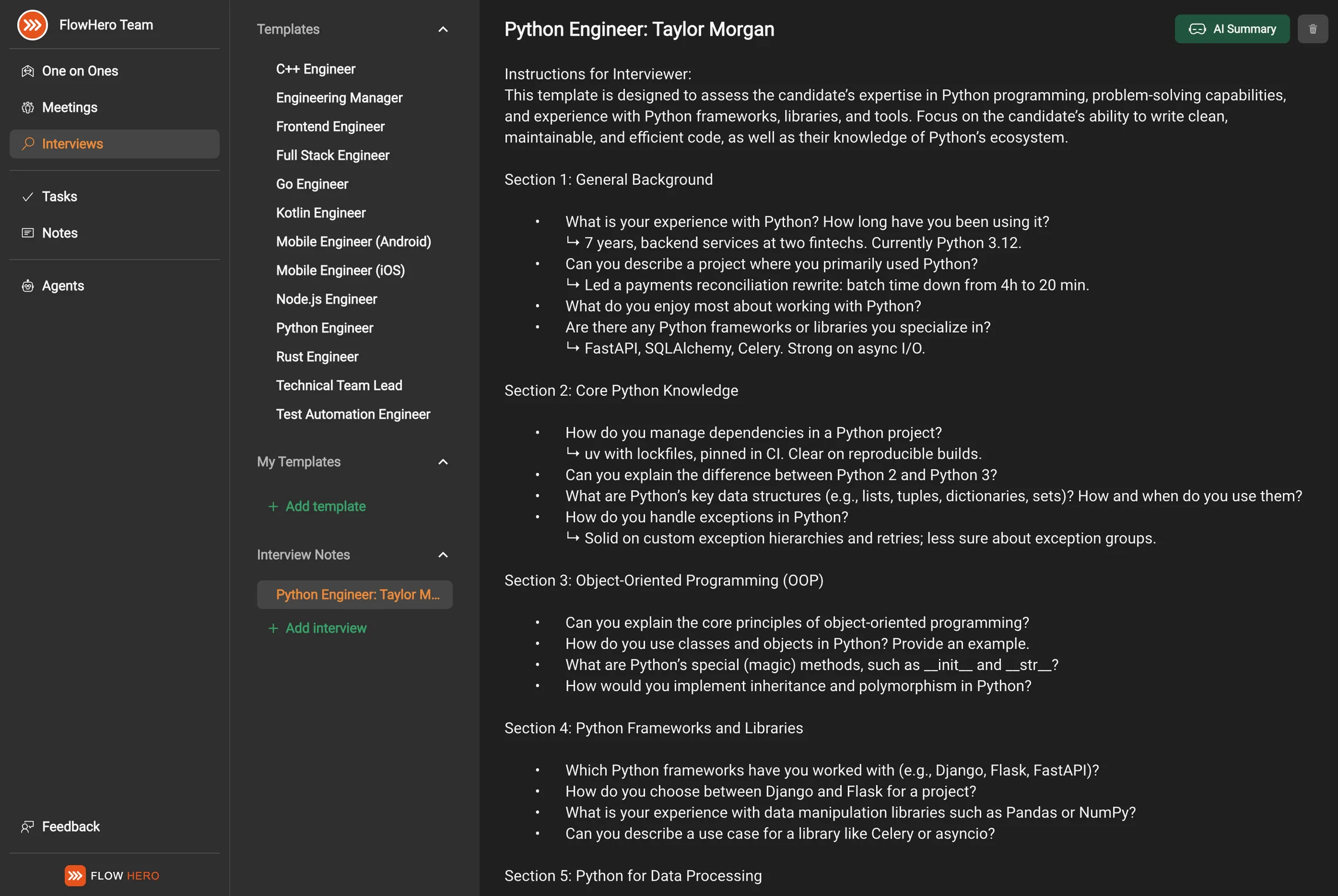
Run this interview in FlowHero
This template is built into FlowHero. Start an interview from it, take notes under each question while you talk, and get an AI summary of your notes to review before the debrief. Start free. No credit card required.
Questions about this template
Can a full stack interview cover everything in an hour?
No. Cover the core sections with everyone, then spend the deep-dive time on the candidate's weaker side of the stack: it shows how they work outside their comfort zone, which full stack work requires.
Should the exercise be frontend or backend?
Both, but thin: one small feature from UI to database. Let the candidate pick their stack, and value a working slice over a polished half.
How do I assess system design for mid-level candidates?
Narrow the scope: design one feature's data model and API, and discuss what breaks first under load. Keep large-scale distributed design for senior candidates.