How to run it in 60 minutes
- 0–5 minIntroductions, the role and how the interview will run
- 5–15 minGeneral background and core Python (sections 1–2)
- 15–40 minCoding exercise with follow-ups (section 7)
- 40–52 minTwo deep-dive sections that match the role, e.g. frameworks and advanced concepts
- 52–60 minCandidate's questions (section 10); write up your scores right after
The questions
01General background
- What is your experience with Python? How long have you been using it?
- Can you describe a project where you primarily used Python?
- What do you enjoy most about working with Python?
- Are there any Python frameworks or libraries you specialize in?
What to listen for
Specifics over adjectives: what they built, their part in it, the scale and what went wrong. Use their project as a thread to come back to in later sections.
02Core Python knowledge
- How do you manage dependencies and virtual environments in a Python project?
- How do you use type hints and dataclasses (or Pydantic) in your code, and what do they catch for you?
- What are Python's key data structures (lists, tuples, dictionaries, sets)? How and when do you use each?
- How do you handle exceptions in Python?
What to listen for
A reproducible setup (lock files, pyproject.toml, uv/Poetry/pip-tools) rather than a global pip install. Data-structure choices explained by cost: set and dict lookups are O(1), tuples are immutable and hashable. Exceptions caught narrowly, never a bare except.
03Object-oriented programming
- Can you explain the core principles of object-oriented programming?
- How do you use classes and objects in Python? Provide an example.
- What are Python's special (magic) methods, such as __init__ and __str__?
- How would you implement inheritance and polymorphism in Python?
What to listen for
Knowing when not to use a class: plain functions, modules and dataclasses are often enough. Strong candidates mention composition over deep inheritance, duck typing, and __repr__ vs __str__.
04Frameworks and libraries
- Which Python frameworks have you worked with (e.g. Django, Flask, FastAPI)?
- How do you choose between Django and Flask (or FastAPI) for a project?
- What is your experience with data manipulation libraries such as pandas or NumPy?
- Can you describe a use case for a library like Celery or asyncio?
What to listen for
Trade-offs, not loyalty: batteries-included Django vs a lightweight framework, sync vs async. For Celery vs asyncio, the key idea is background work across processes vs concurrent I/O within one process.
05Data processing
- How do you process large datasets in Python?
- Have you used Python for web scraping? Which libraries or tools did you use (e.g. BeautifulSoup, Scrapy)?
- How do you optimize memory usage when working with large datasets?
- Can you write a function to parse a JSON file and extract specific fields?
What to listen for
Streaming instead of loading everything: generators, chunked reads, iterators. Awareness of vectorized pandas/NumPy operations vs Python loops, and of when the data belongs in a database instead.
06Testing and debugging
- What is your approach to writing unit tests in Python?
- Can you describe your experience with testing frameworks like pytest or unittest?
- How do you debug Python code? What tools or techniques do you use?
- Can you explain the use of assertions in Python?
What to listen for
Tests as a habit, with examples: pytest fixtures, parametrize, mocking at the boundaries. A real debugger (pdb, IDE breakpoints) and logging, not only print. Knows assert statements are stripped with -O, so they're not for input validation.
07Problem-solving exercise
Give one practical problem and let the candidate talk through it while they code.
Coding challenge (pick one)
- Write a function that returns the nth Fibonacci number recursively, then optimize it.
- Write a script that reads a CSV file, filters rows on a condition and writes the result to a new file.
- Build a small REST API with Flask or FastAPI that supports CRUD operations for one resource.
Follow-up questions
- How would you improve the performance of your solution?
- How would you handle edge cases in your implementation?
What to listen for
Clarifying questions before typing, readable names, and working code before clever code. For Fibonacci: memoization (functools.cache) or iteration, and why naive recursion is exponential. For the CSV task: the csv module or pandas, and streaming instead of reading the whole file.
08Advanced Python concepts
- Can you explain Python's GIL (Global Interpreter Lock) and how it affects multi-threading?
- What is your experience with Python's async/await syntax?
- How do you handle parallel or concurrent processing in Python?
- Can you explain Python decorators? Provide an example.
What to listen for
Threads help I/O-bound work but not CPU-bound work under the GIL; multiprocessing or native extensions do. Senior candidates may mention the optional free-threaded build in recent CPython versions. A decorator they've actually written, ideally with functools.wraps.
09Collaboration and version control
- How do you manage Python projects in a team environment?
- What is your experience with version control tools like Git?
- How do you document your Python code to make it understandable for others?
- Have you contributed to any open-source Python projects?
What to listen for
Shared tooling that removes arguments: formatters and linters (Black, Ruff), type checking in CI, small reviewed pull requests. Docstrings and READMEs written for the next person.
10Closing questions
- What Python features or libraries are you currently exploring?
- How do you stay updated on the latest Python developments?
- Do you have any questions for us about the role or the team?
What to listen for
Genuine curiosity. The candidate's own questions often tell you more about what they care about than any answer they gave.
Scorecard
Rate each competency from 1 to 4 straight after the interview, before you compare notes with other interviewers, and write down the evidence behind every score.
| Competency | What to assess | Score |
|---|---|---|
| Python fundamentals | data structures, exceptions, typing, idiomatic code | 1–4 |
| Design | OOP vs functions, composition, clear interfaces | 1–4 |
| Ecosystem | frameworks, data libraries, dependency management | 1–4 |
| Problem solving | coding exercise: approach, correctness, edge cases | 1–4 |
| Quality | testing habits, debugging, readability | 1–4 |
| Concurrency & performance | GIL, async, multiprocessing, memory | 1–4 |
| Collaboration | communication, code review, documentation | 1–4 |
- 1 · No evidence
- Couldn't answer, or the answer was wrong.
- 2 · Partial
- Knows the concept, but couldn't apply it or needed heavy prompting.
- 3 · Solid
- Correct and applied it to a real example, with minor gaps.
- 4 · Strong
- Clear, correct, discussed trade-offs and went beyond the question.
Run this interview in FlowHero
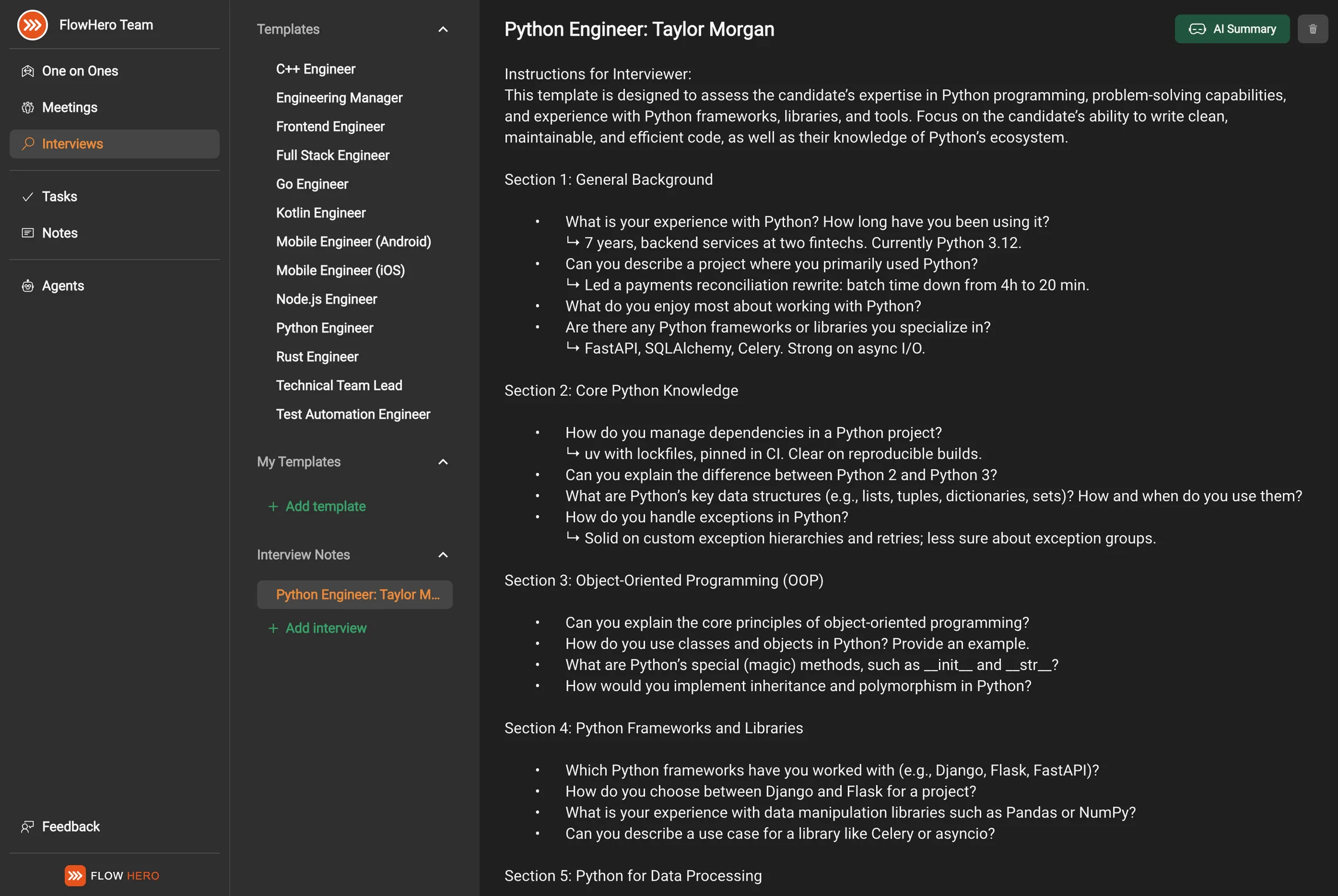
This template is built into FlowHero. Start an interview from it, take notes under each question while you talk, and get an AI summary of your notes to review before the debrief. Start free. No credit card required.
Questions about this template
How long should a Python engineer interview be?
About 60 minutes for one technical round. More than that and the candidate tires and your notes get thinner. If you need more depth, split it into two focused rounds, for example coding and system design.
Should I ask all 40 questions?
No. Ask the same core sections (1, 2 and 7) to every candidate so scores are comparable, then pick one or two deep-dive sections that match the role. Two well-explored questions tell you more than ten rushed ones.
Does this work for junior and senior candidates?
Yes, by changing the depth rather than the questions. For junior candidates, focus on fundamentals and the coding exercise. For senior candidates, push on trade-offs, concurrency, testing strategy and how they've raised the bar for their team.
How do I keep scoring fair across interviewers?
Score each competency right after the interview, before you discuss the candidate with others, and write down the evidence behind each score. In FlowHero, your notes sit under each of this template's questions, and an AI summary condenses them for you to review before the debrief.