How to run it in 60 minutes
- 0–5 minIntroductions, the role and how the interview will run
- 5–15 minBackground and language fundamentals (sections 1–2)
- 15–40 minCoding exercise with follow-ups (section 11)
- 40–52 minConcurrency and error handling (sections 3–4), or APIs (5) for service-heavy roles
- 52–60 minCandidate's questions (section 13); write up your scores right after
The questions
01General background
- How long have you been working with Go?
- What types of projects have you built using Go?
- Why did you choose Go over other programming languages?
- Are you familiar with the Go ecosystem and community standards?
What to listen for
Production Go (services, CLIs, infrastructure) and why Go was the right fit for it.
02Language fundamentals
- Can you explain the philosophy behind Go’s simplicity and design?
- What are Go’s key features, and how do they benefit developers?
- How does garbage collection work in Go?
- What is the difference between slices and arrays in Go?
What to listen for
Simplicity as a feature: a small language, explicit errors, composition through small interfaces. Slices are views over arrays with a length and capacity, and append may reallocate. The garbage collector is concurrent and tuned with GOGC and GOMEMLIMIT.
03Concurrency and parallelism
- Can you explain how goroutines and channels work?
- What are the advantages of Go’s concurrency model over traditional threading?
- How do you handle synchronization between goroutines?
- Can you describe a scenario where you used select with channels?
What to listen for
Goroutines are cheap; channels for passing ownership, mutexes for shared state, and knowing which fits. WaitGroup, errgroup and context for cancellation. How goroutine leaks happen and how to prevent them. select with timeouts or ctx.Done().
04Error handling
- How does error handling in Go differ from other languages?
- What is your approach to handling errors in complex applications?
- How do you wrap and propagate errors effectively?
- Can you explain the use of defer, recover, and panic in Go?
What to listen for
Errors as values, wrapped with %w and checked with errors.Is and errors.As. panic only for programmer errors, recover only at boundaries. defer for cleanup.
05API development
- Have you built RESTful or gRPC APIs using Go?
- What libraries or frameworks do you use for API development in Go (e.g., Gin, Echo)?
- How do you handle input validation and error responses in APIs?
- How would you optimize API performance in high-traffic scenarios?
What to listen for
The standard net/http package before reaching for a framework (its router has supported methods and path patterns since Go 1.22). Validation at the edge, consistent error responses, timeouts on servers and clients, context passed through.
06Testing and debugging
- What is your experience with Go’s built-in testing package?
- How do you write unit tests for your Go code?
- Can you explain the use of table-driven tests in Go?
- What tools do you use for debugging and profiling Go applications?
What to listen for
Table-driven tests with t.Run subtests, httptest for handlers, the race detector (-race), fuzzing and benchmarks.
07Tooling and libraries
- What Go tools or libraries do you use to improve development workflows?
- How do you manage dependencies in Go projects (e.g., go mod)?
- Which formatting and linting tools do you use (e.g. gofmt, go vet, golangci-lint)?
- Can you describe your experience with Go frameworks for web development or databases?
What to listen for
go mod for dependencies; gofmt, go vet and golangci-lint or staticcheck in CI. golint is deprecated, so mentioning it as current is a small flag.
08Performance and optimization
- What techniques do you use to optimize Go applications?
- How do you measure and improve the performance of a Go program?
- Can you explain how Go’s memory management affects performance?
- Have you used tools like pprof to identify bottlenecks in Go applications?
What to listen for
Measure first with pprof and benchmarks. Then reduce allocations, reuse buffers (sync.Pool with care) and check escape analysis.
09Database and data management
- What databases have you used with Go?
- How do you manage database connections in Go applications?
- Have you worked with ORMs or query builders like GORM or sqlx?
- How do you handle transactions and error handling in database operations?
What to listen for
database/sql connection pool settings, context timeouts on queries, transactions with a deferred rollback. Trade-offs between sqlc or sqlx and an ORM like GORM.
10DevOps and deployment
- Have you deployed Go applications in production?
- Can you explain how to build and distribute Go binaries?
- How do you handle environment variables and configuration in Go?
- What is your experience with containerization tools like Docker for Go apps?
What to listen for
Static binaries and cross-compilation (GOOS, GOARCH), small container images, configuration from the environment, graceful shutdown on SIGTERM.
11Problem-solving exercise
Give one practical problem and let the candidate talk through it while they code.
Coding challenge (pick one)
- Write a Go program to fetch data from an external API and process it concurrently.
- Implement a simple RESTful API for managing a list of tasks.
- Write a function to parse a large JSON file and extract specific data efficiently.
Follow-up questions
- How would you optimize your solution?
- How would you test your implementation?
What to listen for
Idiomatic concurrency with a bounded number of workers, errors collected with errgroup, cancellation through context. Bonus if they run the tests with -race.
12Collaboration and code management
- How do you ensure your Go code is readable and maintainable for a team?
- What is your experience with version control systems like Git?
- Have you contributed to open-source Go projects?
- How do you handle code reviews and feedback?
What to listen for
gofmt ends style debates, so reviews can focus on clarity, error handling and naming.
13Closing questions
- What Go features or libraries are you currently exploring?
- How do you stay updated on the latest trends and best practices in Go?
- Do you have any questions for us about the role or the team?
What to listen for
Interest in recent Go releases (generics, iterators, toolchain changes) and how they decide what to adopt.
Scorecard
Rate each competency from 1 to 4 straight after the interview, before you compare notes with other interviewers, and write down the evidence behind every score.
| Competency | What to assess | Score |
|---|---|---|
| Language fundamentals | slices, interfaces, memory, idiomatic Go | 1–4 |
| Concurrency | goroutines, channels, sync, context | 1–4 |
| Error handling | wrapping, propagation, panics | 1–4 |
| APIs and services | net/http, validation, timeouts | 1–4 |
| Testing and tooling | table-driven tests, -race, linters | 1–4 |
| Performance | profiling, allocations, benchmarks | 1–4 |
| Problem solving | coding exercise: approach, correctness, edge cases | 1–4 |
| Collaboration | readability, code review, communication | 1–4 |
- 1 · No evidence
- Couldn't answer, or the answer was wrong.
- 2 · Partial
- Knows the concept, but couldn't apply it or needed heavy prompting.
- 3 · Solid
- Correct and applied it to a real example, with minor gaps.
- 4 · Strong
- Clear, correct, discussed trade-offs and went beyond the question.
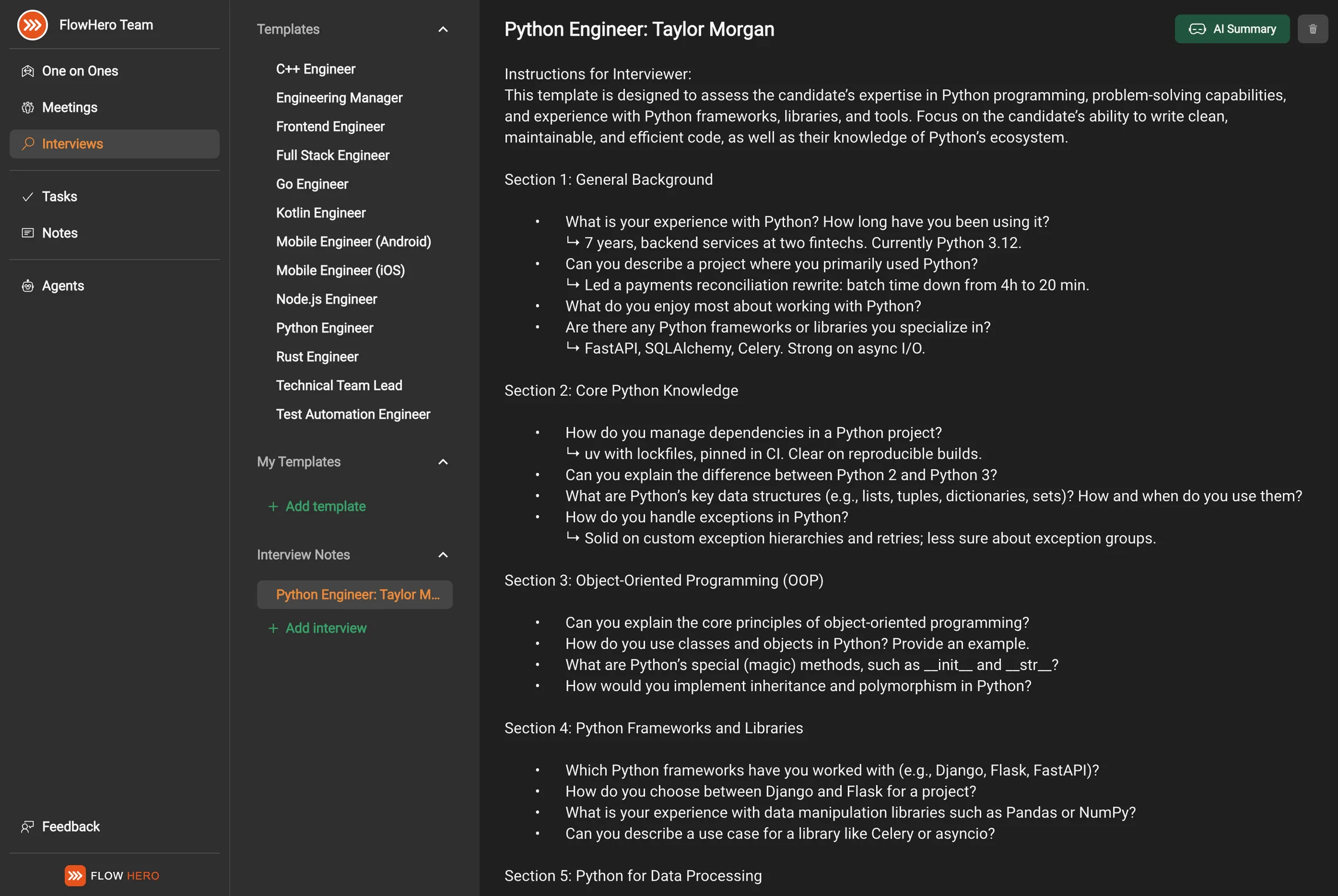
Run this interview in FlowHero
This template is built into FlowHero. Start an interview from it, take notes under each question while you talk, and get an AI summary of your notes to review before the debrief. Start free. No credit card required.
Questions about this template
What's the most important area to test in a Go interview?
Concurrency. Ask the candidate to explain a goroutine leak and a data race, and how they'd find each (pprof's goroutine profile, the -race flag). It separates people who've run Go in production from those who've read about it.
Should candidates use a framework in the exercise?
The standard library is enough for an interview-sized API. A framework is fine if they can explain what it does for them.
Can I use this for engineers moving to Go from another language?
Yes. Weigh Go-specific idioms less, and concurrency concepts, testing and engineering judgment more. Ask what surprised them about Go.