How to run it in 60 minutes
- 0–5 minIntroductions, the role and how the interview will run
- 5–15 minBackground and language fundamentals (sections 1–2)
- 15–40 minCoding exercise with follow-ups (section 9)
- 40–52 minError handling and concurrency (sections 3–4), or systems programming (7) for low-level roles
- 52–60 minCandidate's questions (section 11); write up your scores right after
The questions
01General background
- How long have you been working with Rust?
- What types of projects have you built using Rust?
- Why did you choose Rust for those projects?
- What do you like most about programming in Rust?
What to listen for
What they built and why Rust was worth its learning curve for it. Their honest view of where Rust is a poor fit.
02Language fundamentals
- Can you explain Rust’s ownership model and how it enforces memory safety?
- What are lifetimes, and how do they work in Rust?
- How do you manage immutable and mutable references in Rust?
- What is the difference between Box, Rc, and Arc in Rust?
What to listen for
Ownership: one owner, moves, and borrowing rules (many shared references or one mutable one). Lifetimes describe relationships the compiler checks, and most are inferred. Box for heap allocation and trait objects, Rc for shared ownership on one thread, Arc across threads, usually with a Mutex or RwLock for mutation.
03Error handling
- How does Rust handle errors compared to other languages?
- What is the difference between Result and Option?
- How do you propagate errors in Rust?
- Can you explain the use of the ? operator?
What to listen for
Option for absence, Result for failure, ? to propagate errors with From conversions. thiserror for libraries, anyhow for applications. unwrap only where failure is impossible, and expect with a message otherwise.
04Concurrency and asynchronous programming
- How does Rust’s concurrency model ensure thread safety?
- Can you explain the use of Send and Sync traits in Rust?
- What is your experience with Rust’s async/await syntax?
- Have you used an async runtime like Tokio? What are the trade-offs of async Rust?
What to listen for
Send and Sync explained by what the compiler prevents. Async needs a runtime (Tokio); blocking inside async code stalls it, so heavy work goes to spawn_blocking.
05Performance and optimization
- How does Rust achieve high performance compared to languages like C or C++?
- What tools or techniques do you use to profile and optimize Rust applications?
- Can you explain zero-cost abstractions in Rust?
- How do you avoid common performance pitfalls in Rust?
What to listen for
No garbage collector, monomorphization, and iterators that compile down to plain loops. Profiling with flame graphs and benchmarking with criterion. Avoiding needless clones and allocations, and always measuring release builds.
06Rust ecosystem and tooling
- What crates (libraries) have you used in your projects, and why?
- How do you manage dependencies in Rust using cargo?
- Have you contributed to any open-source Rust projects?
- What is your experience with Rust’s package registry, crates.io?
What to listen for
Choosing crates by maintenance and adoption, Cargo features and workspaces, clippy and rustfmt in CI, cargo audit or cargo deny for dependencies.
07Systems programming
- Have you built low-level or systems-level applications using Rust?
- How do you handle interop between Rust and C (e.g., using unsafe or FFI)?
- Can you explain how Rust handles memory allocation and deallocation?
- Have you worked with Rust’s standard library for file I/O and threading?
What to listen for
unsafe kept small, isolated and documented with its safety invariants. FFI with bindgen or cbindgen, and clear rules for who owns memory across the boundary.
08Testing and debugging
- How do you write unit and integration tests in Rust?
- What is your experience with Rust’s testing framework?
- Can you explain how to use cargo test and cargo bench?
- How do you debug Rust applications during development?
What to listen for
Unit tests next to the code, integration tests in tests/, doc tests, benchmarks with criterion, and tracing for debugging async code.
09Problem-solving exercise
Give one practical problem and let the candidate talk through it while they code.
Coding challenge (pick one)
- Implement a thread-safe shared counter using Rust’s concurrency primitives.
- Build a simple HTTP server in Rust (e.g. with axum or Actix Web).
- Parse a large CSV file and calculate some aggregate statistics.
Follow-up questions
- How did you approach the problem?
- How would you test your solution?
- What trade-offs did you consider during implementation?
What to listen for
Counter: Arc<Mutex<u64>> or an AtomicU64, and why the atomic is enough. HTTP server: axum or Actix Web on Tokio. CSV: stream rows with the csv crate and serde rather than loading the whole file. Working with the borrow checker instead of cloning everything.
10Collaboration and code management
- How do you ensure your Rust code is maintainable and idiomatic?
- What is your experience with version control systems like Git?
- How do you handle code reviews and feedback?
- Have you collaborated on large Rust projects with a team?
What to listen for
clippy and rustfmt as shared standards, reviews that focus on API design and error handling, experience in larger codebases with workspaces.
11Closing questions
- What are your favorite features of Rust?
- How do you stay updated on the latest developments in the Rust ecosystem?
- Do you have any questions for us about the role or our Rust-related projects?
What to listen for
Interest in where the language is going and their own questions about the team's Rust code.
Scorecard
Rate each competency from 1 to 4 straight after the interview, before you compare notes with other interviewers, and write down the evidence behind every score.
| Competency | What to assess | Score |
|---|---|---|
| Ownership and borrowing | moves, borrows, lifetimes, smart pointers | 1–4 |
| Error handling | Result, Option, ?, error types | 1–4 |
| Concurrency and async | Send/Sync, threads, Tokio | 1–4 |
| Performance | profiling, allocations, zero-cost abstractions | 1–4 |
| Ecosystem and tooling | Cargo, crates, clippy, testing | 1–4 |
| Systems programming | unsafe, FFI, memory (if relevant to the role) | 1–4 |
| Problem solving | coding exercise: approach, correctness, edge cases | 1–4 |
| Collaboration | readability, code review, communication | 1–4 |
- 1 · No evidence
- Couldn't answer, or the answer was wrong.
- 2 · Partial
- Knows the concept, but couldn't apply it or needed heavy prompting.
- 3 · Solid
- Correct and applied it to a real example, with minor gaps.
- 4 · Strong
- Clear, correct, discussed trade-offs and went beyond the question.
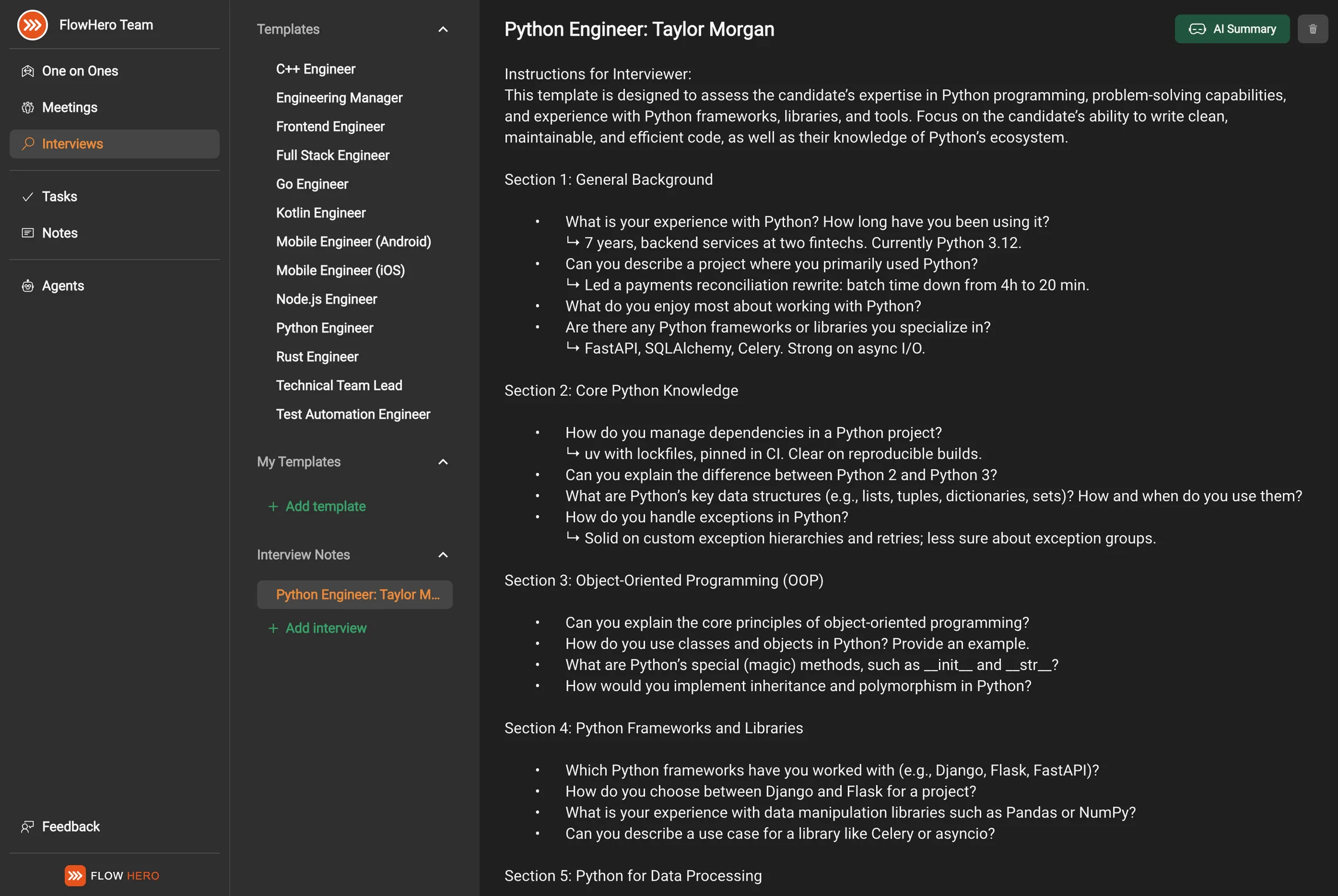
Run this interview in FlowHero
This template is built into FlowHero. Start an interview from it, take notes under each question while you talk, and get an AI summary of your notes to review before the debrief. Start free. No credit card required.
Questions about this template
How do I interview experienced developers who are new to Rust?
Focus on how they learned ownership and what changed in how they design code. Weigh transferable skills (testing, design, debugging) more than Rust-specific trivia, and let them use documentation during the exercise.
Do I need to cover unsafe Rust?
Only for systems, embedded or FFI-heavy roles. For most backend work, knowing when unsafe is needed and how to keep it contained is enough.
How long should the Rust coding exercise be?
About 25–30 minutes, with documentation allowed. Rust's compiler is strict, so judge the approach and how they respond to compiler errors, not how fast they type.