How to run it in 60 minutes
- 0–5 minIntroductions, the role and how the interview will run
- 5–15 minGeneral background and core C++ (sections 1–2)
- 15–40 minCoding exercise with follow-ups (section 7)
- 40–52 minTwo deep-dive sections that match the role, e.g. the STL and advanced concepts (4–5) or concurrency (6)
- 52–60 minCandidate's questions (section 10); write up your scores right after
The questions
01General background
- Can you share your experience with C++? How long have you been using it?
- What type of projects have you worked on primarily using C++?
- What do you consider the strengths of C++ compared to other programming languages?
- Which C++ standards (C++11 through C++23) have you used, and which of their features do you rely on most?
What to listen for
Which kind of C++ they write (embedded, games, trading, systems, backend): the skills differ a lot. Which standard they use day to day and why. Follow their main project through later sections.
02Core C++ knowledge
- What are the key differences between C and C++?
- How does C++ support object-oriented programming?
- Can you explain the differences between pointers and references?
- How is memory management handled in C++? What are new and delete used for?
What to listen for
Pointers can be null and re-pointed; references can't. In modern code new and delete are rare: ownership lives in smart pointers and containers. Mentioning object lifetime and undefined behavior unprompted is a good sign.
03Object-oriented programming (OOP)
- What are the four pillars of object-oriented programming? How does C++ implement them?
- Can you provide an example of polymorphism in C++?
- How do you implement inheritance in C++? What are the differences between public, private, and protected inheritance?
- What are virtual functions, and why are they used?
What to listen for
The cost of virtual dispatch (vtable lookup, no inlining) and why base classes need a virtual destructor. Strong candidates know when composition, templates or std::variant beat an inheritance hierarchy.
04C++ standard library (STL)
- What is the purpose of the Standard Template Library (STL) in C++?
- How do you choose the right container (e.g., vector, list, map)?
- Can you explain the difference between std::vector and std::array?
- How do you use std::shared_ptr and std::unique_ptr for memory management?
What to listen for
std::vector as the default container because of cache locality; std::array is fixed-size with no heap allocation. unique_ptr for single ownership, shared_ptr only when ownership is truly shared, weak_ptr to break cycles. Iterator invalidation is a senior signal.
05Advanced concepts
- What are templates in C++? Can you explain the difference between function templates and class templates?
- What are concepts (C++20), and how do they improve template code?
- Can you explain the C++11 feature std::move and how it improves performance?
- What is the RAII (Resource Acquisition Is Initialization) principle, and how does C++ support it?
What to listen for
RAII explained as tying a resource's lifetime to an object's scope, with a real example (locks, files, sockets). std::move is only a cast; the move happens in the move constructor. Rule of zero or five. Concepts make template constraints explicit and errors readable.
06Multithreading and concurrency
- What is your experience with multithreading in C++?
- How do you synchronize threads in C++?
- Can you explain the use of std::mutex and std::lock_guard?
- What is the difference between threads and tasks in C++?
What to listen for
Data races vs race conditions. lock_guard or scoped_lock for exception-safe locking, condition variables for waiting, atomics for simple counters. std::async and futures vs managing threads directly. Deadlock avoidance through consistent lock order or scoped_lock on several mutexes.
07Problem-solving exercise
Give one practical problem and let the candidate talk through it while they code.
Coding challenge (pick one)
- Write a C++ program to reverse a linked list.
- Implement a thread-safe queue using STL or raw C++ constructs.
- Write a program to find the nth Fibonacci number using dynamic programming.
Follow-up questions
- How would you optimize your solution?
- How would you test your code for edge cases?
What to listen for
Modern idioms: no manual new/delete, const-correctness, references to avoid copies. For the thread-safe queue: a mutex plus a condition_variable, so pop waits without busy-looping. Edge cases: empty input, one element, and integer overflow for large Fibonacci numbers.
08Debugging and optimization
- How do you approach debugging in C++?
- What tools do you use for profiling or performance analysis?
- How do you find and prevent memory leaks in C++?
- How would you optimize a program with high computational complexity?
What to listen for
Real tools: gdb or lldb, AddressSanitizer and UBSan, Valgrind, perf or VTune. Measure before optimizing: algorithmic wins first, then memory layout and allocations.
09Collaboration and version control
- How do you manage C++ projects in a collaborative environment?
- What is your experience with build systems like CMake or Makefiles?
- How do you document your code for team members or future maintainers?
- Have you contributed to any open-source C++ projects?
What to listen for
CMake built around targets, a package manager (vcpkg, Conan), clang-format and clang-tidy in CI, warnings treated as errors. Reviews that look at ownership and lifetimes, not only style.
10Closing questions
- What C++ features are you currently exploring or excited about?
- How do you stay updated on the latest developments in C++?
- Do you have any questions for us about the role or the team?
What to listen for
Interest in recent standards (ranges, coroutines, modules) shows they keep current. Their own questions often tell you more about what they care about than any answer.
Scorecard
Rate each competency from 1 to 4 straight after the interview, before you compare notes with other interviewers, and write down the evidence behind every score.
| Competency | What to assess | Score |
|---|---|---|
| Language fundamentals | pointers, references, object lifetime, undefined behavior | 1–4 |
| Memory and resources | RAII, smart pointers, clear ownership | 1–4 |
| Design | OOP, templates, interfaces, when to use which | 1–4 |
| Standard library | containers, algorithms, choosing the right one | 1–4 |
| Concurrency | threads, synchronization, atomics | 1–4 |
| Problem solving | coding exercise: approach, correctness, edge cases | 1–4 |
| Tooling and quality | debuggers, sanitizers, profilers, build systems | 1–4 |
| Collaboration | communication, code review, documentation | 1–4 |
- 1 · No evidence
- Couldn't answer, or the answer was wrong.
- 2 · Partial
- Knows the concept, but couldn't apply it or needed heavy prompting.
- 3 · Solid
- Correct and applied it to a real example, with minor gaps.
- 4 · Strong
- Clear, correct, discussed trade-offs and went beyond the question.
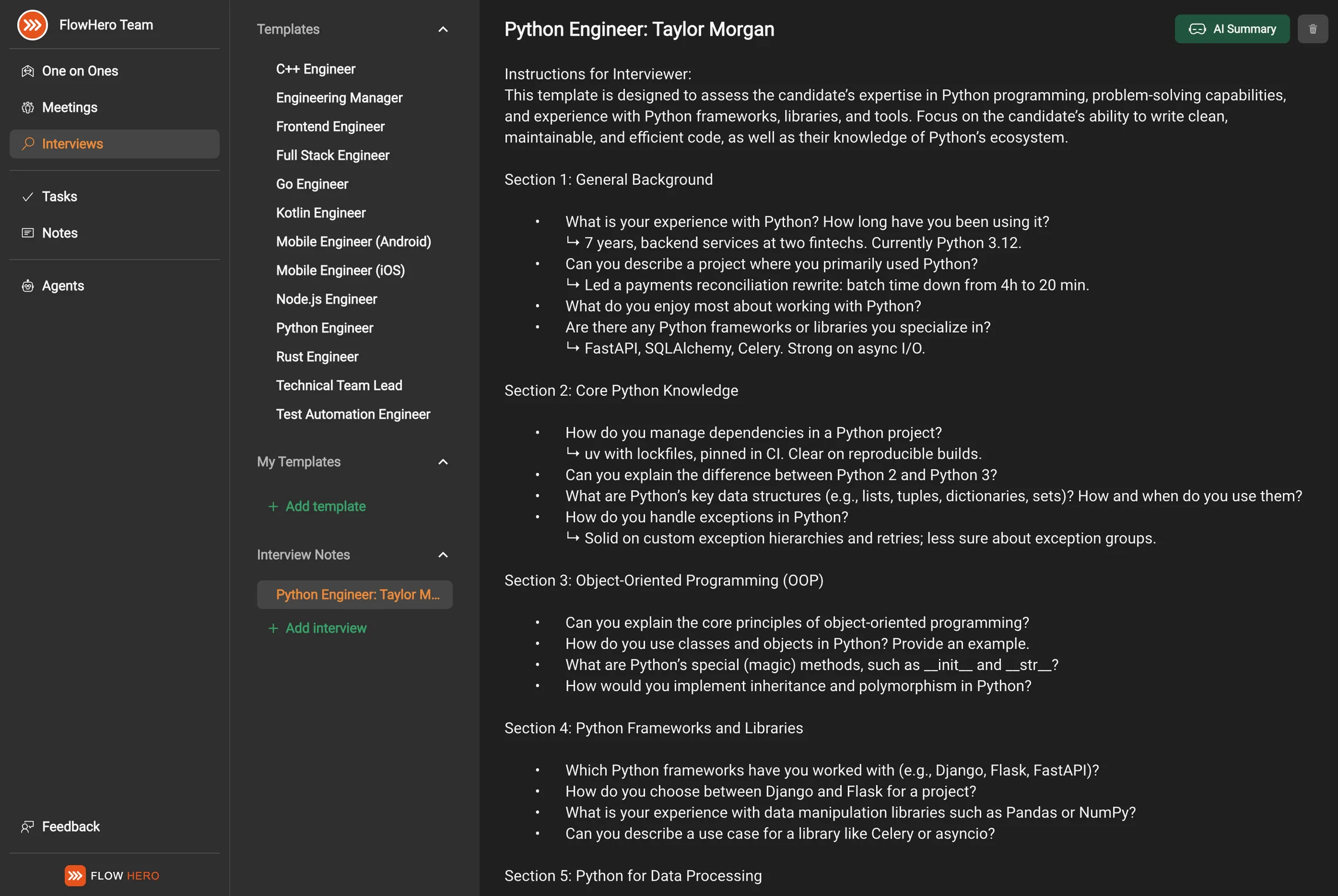
Run this interview in FlowHero
This template is built into FlowHero. Start an interview from it, take notes under each question while you talk, and get an AI summary of your notes to review before the debrief. Start free. No credit card required.
Questions about this template
How long should a C++ interview be?
About 60 minutes for one technical round. If performance or low-level systems work is central to the role, add a separate round for it rather than stretching this one.
Should candidates write C++ on a whiteboard or in an editor?
In an editor with a compiler, ideally with warnings turned on. It's closer to real work, and a whiteboard mostly tests syntax recall, which tells you little about a C++ engineer.
How do I adapt this template for embedded or game development roles?
Keep the core sections and change the deep dives. For embedded: memory limits, no heap or exceptions, volatile and interrupts. For games: data-oriented design, cache behavior and frame-time budgets.