How to run it in 60 minutes
- 0–5 minIntroductions, the role and how the interview will run
- 5–15 minBackground and automation frameworks (sections 1–2)
- 15–35 minCoding: write two or three automated tests for a sample page or API (section 4)
- 35–50 minScenarios and flaky tests (sections 8–9)
- 50–60 minCandidate's questions (section 10); write up your scores right after
The questions
01General background
- Can you tell us about your experience as a Test Automation Engineer?
- What types of applications (e.g., web, mobile, API) have you tested using automation?
- What motivated you to specialize in test automation?
- Can you describe a challenging automation project you worked on?
What to listen for
What they automated (web, mobile, API) and what impact it had: release speed, escaped bugs, manual effort saved.
02Automation frameworks
- What automation frameworks are you most familiar with (e.g., Selenium, Cypress, Playwright)?
- How do you decide which framework to use for a specific project?
- Can you walk us through a framework you’ve implemented from scratch?
- How do you ensure the scalability and maintainability of your automation framework?
What to listen for
Framework chosen to fit the app and team: Playwright for modern web (auto-waiting, parallel runs), Cypress, Selenium for broad browser coverage, Appium for mobile. Page objects or similar patterns, fixtures, reusable helpers and clear reports.
03Test strategy and planning
- How do you design an automated test plan for a new feature or application?
- What’s your approach to balancing automated testing with manual testing?
- How do you prioritize which test cases to automate first?
- How do you handle tests for features that are frequently changing?
What to listen for
Risk-based priorities and a testing pyramid: most checks at the unit and API level, fewer UI tests. Automation for regression; manual and exploratory testing for new features and UX.
04Technical skills and coding
- What programming languages are you most comfortable using for automation?
- Can you write a function that validates an email address in your preferred programming language?
- How do you handle dynamic elements or asynchronous behavior in automated tests?
- Can you share an example where you debugged a failing test and identified the root cause?
What to listen for
Clean, readable test code. Waiting on conditions instead of fixed sleeps. For the email check: a reasonable regex or library plus good test cases, and knowing that perfect email validation is impractical.
05Tools and technologies
- What tools have you used for CI/CD integration of automated tests?
- How do you manage test data and environments for automation?
- Have you worked with any performance testing tools (e.g., JMeter, Gatling)?
- Can you explain how you’ve used version control (e.g., Git) in your testing workflows?
What to listen for
Tests running in CI on every pull request, in parallel. Test data created per test or seeded through an API, isolated environments. Load testing tools such as k6, JMeter or Gatling.
06Quality assurance processes
- How do you ensure automated tests cover all critical paths and edge cases?
- Can you describe how you’ve integrated automated tests into the development lifecycle?
- What’s your approach to measuring the effectiveness of automated tests?
- How do you communicate test results and issues to developers and stakeholders?
What to listen for
Coverage chosen by risk, not a 100% target. Useful measures: escaped defects, flake rate, suite run time. Results reported so developers can act on them quickly.
07Collaboration and communication
- How do you collaborate with developers to ensure testability of the code?
- Have you worked closely with product managers or QA teams? If yes, how?
- How do you handle situations where developers push back on fixing bugs found during testing?
- How do you ensure your test scripts are understood by others in your team?
What to listen for
Testability built in with developers (stable test IDs, APIs for setup). Bugs reported with impact and clear reproduction steps.
08Scenario-based questions
Scenario 1
- A critical production issue slips past your automated tests. How do you address it?
Scenario 2
- You inherit a brittle test suite with many failing tests. What steps do you take to improve it?
Scenario 3
- A new feature has no existing test cases. How do you approach writing automated tests for it?
What to listen for
Escaped bug: fix it, add a test at the right level and find the gap in the process. Brittle suite: quarantine flaky tests, fix root causes, delete low-value tests. New feature: start from acceptance criteria and risks.
09Problem-solving and critical thinking
- What’s the most complex automation script you’ve written, and what made it challenging?
- Can you describe a time when your automation work significantly reduced testing time?
- How do you ensure your tests remain reliable as the application evolves?
- How do you handle flaky tests in your automation suite?
What to listen for
Flaky tests treated as bugs with root causes (timing, test data, environment), not just retried until green.
10Closing questions
- What excites you most about this role and our testing environment?
- Do you have any questions about the team, tools, or projects?
- Is there anything else you’d like us to know about your experience or approach to automation testing?
What to listen for
Interest in improving how the team ships, not only in the tools, and their own questions about the current test setup.
Scorecard
Rate each competency from 1 to 4 straight after the interview, before you compare notes with other interviewers, and write down the evidence behind every score.
| Competency | What to assess | Score |
|---|---|---|
| Automation frameworks | choice, design, maintainability | 1–4 |
| Coding | clean test code, waits, debugging | 1–4 |
| Test strategy | risk-based priorities, testing pyramid | 1–4 |
| CI and tooling | pipelines, test data, environments | 1–4 |
| Reliability | flaky tests, suite maintenance | 1–4 |
| Quality advocacy | working with developers and product | 1–4 |
| Problem solving | scenarios: structure, root causes | 1–4 |
- 1 · No evidence
- Couldn't answer, or the answer was wrong.
- 2 · Partial
- Knows the concept, but couldn't apply it or needed heavy prompting.
- 3 · Solid
- Correct and applied it to a real example, with minor gaps.
- 4 · Strong
- Clear, correct, discussed trade-offs and went beyond the question.
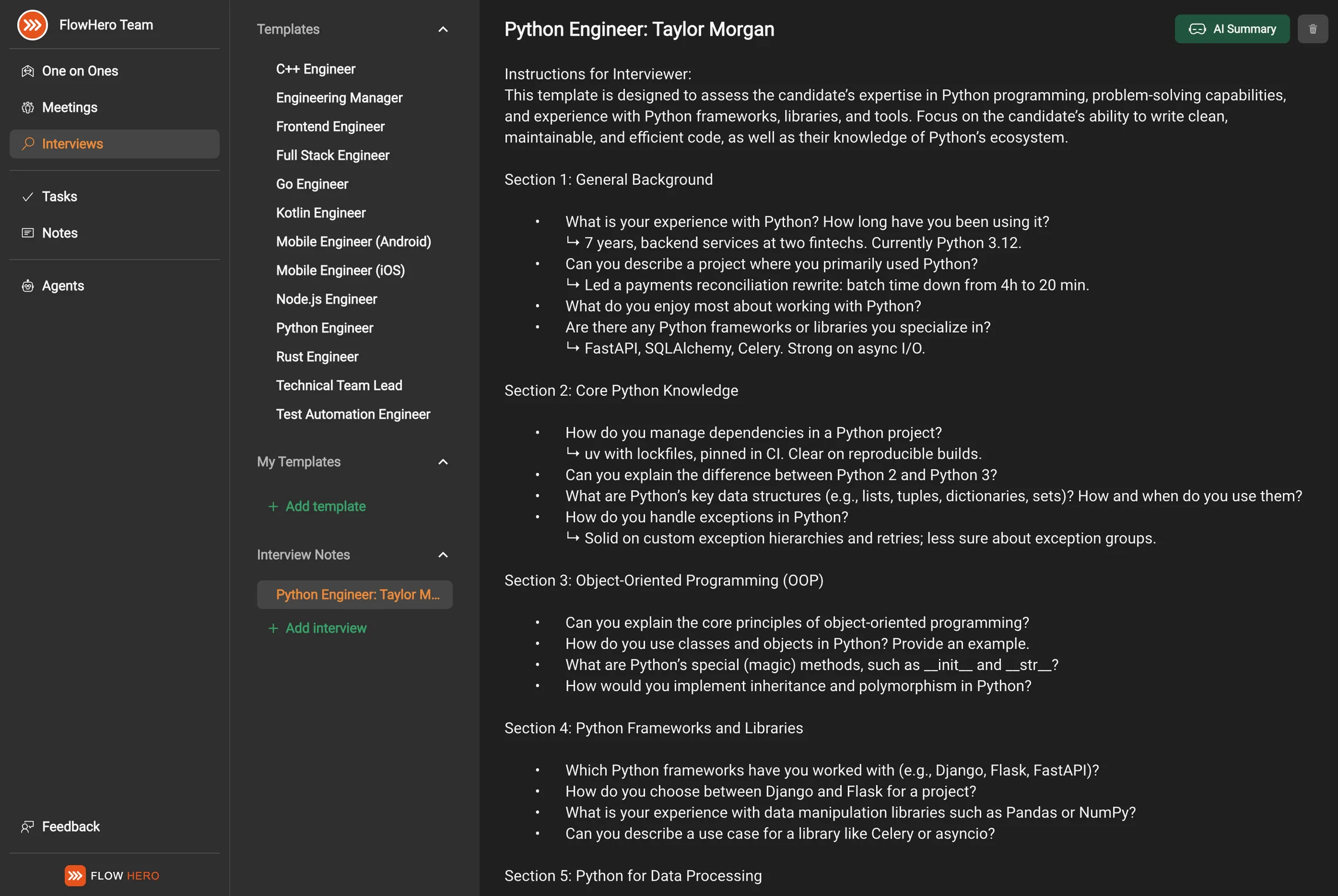
Run this interview in FlowHero
This template is built into FlowHero. Start an interview from it, take notes under each question while you talk, and get an AI summary of your notes to review before the debrief. Start free. No credit card required.
Questions about this template
Should test automation engineers do a coding exercise?
Yes. Writing tests is writing code. Give them a small sample page or API and ask for two or three meaningful tests; it shows more than any question about frameworks.
Playwright, Cypress or Selenium in the interview?
Let candidates use the framework they know and ask why they'd choose it. Strong candidates can explain the trade-offs of the others too.
Does this template work for SDET roles?
Yes. For SDET roles, spend more time on coding and on test infrastructure design (parallelism, test data services, reporting), and consider a regular coding round as well.