How to run it in 60 minutes
- 0–5 minIntroductions, the role and how the interview will run
- 5–15 minBackground and Kotlin (section 1 and the start of 2)
- 15–40 minApp exercise, scoped to one screen (section 3)
- 40–52 minArchitecture and lifecycle, networking and offline (the rest of section 2)
- 52–60 minCandidate's questions (section 7); write up your scores right after
The questions
01General background
- Tell me about your experience as an Android developer. What types of apps have you built?
- What programming languages do you typically use for Android development, and why?
- Can you describe a challenging project you worked on? What was the challenge, and how did you resolve it?
- Have you published any apps to the Google Play Store? Can you walk us through the process?
What to listen for
Apps they shipped, at what scale (users, ratings), and their part in them. Experience with the Play release process beyond pressing "upload".
02Technical skills
Kotlin and Java
- What are the key differences between Kotlin and Java? When would you choose one over the other?
- Can you explain Kotlin’s coroutines and how they improve asynchronous programming?
- How do you manage null safety in Android apps?
Android architecture and lifecycle
- How do you structure an Android project? Do you follow any specific architectural patterns (e.g., MVVM, MVP)?
- Can you explain the Android activity and fragment lifecycle?
- How do you handle configuration changes (e.g., screen rotations)?
UI and UX development
- How do you create responsive designs that work across multiple screen sizes and resolutions?
- Can you explain the use of Jetpack Compose? Have you used it in any of your projects?
- How do you implement custom views in Android?
Networking and APIs
- How do you manage API calls in Android apps? Do you use Retrofit, Ktor or another library?
- Can you describe how you would implement offline capabilities for an app?
- How do you handle pagination in a list with data from an API?
Performance optimization
- What steps do you take to improve app performance?
- How do you monitor and debug memory leaks in your apps?
- Can you share an example of optimizing an app’s load time or responsiveness?
What to listen for
Kotlin first, Java for legacy code. MVVM with one-way data flow; ViewModels survive configuration changes and SavedStateHandle covers process death. Compose for new UI. Retrofit or Ktor with a local database (Room) as the source of truth for offline, Paging for long lists. Performance work with profilers, LeakCanary and Baseline Profiles.
03Problem-solving exercise
Give one realistic problem, scoped down to fit the time, and let the candidate talk through it while they build.
Coding challenge (pick one)
- Create a simple weather app that fetches weather data from an API and displays it in a list (RecyclerView or a Compose LazyColumn).
- Build a to-do list app that allows users to add, delete, and edit tasks, with local storage support.
Follow-up questions
- How would you test this implementation?
- What changes would you make to scale this app for a larger user base?
What to listen for
Scope it to one screen with real or fake data. Look for UI separated from data, loading and error states, rotation handled correctly, and a plan for tests (ViewModel unit tests, Compose UI tests).
04Google Play and deployment
- Can you walk me through the process of deploying an app to the Google Play Store?
- How do you handle app versioning and updates?
- Have you implemented in-app purchases or subscriptions in an Android app? If yes, can you describe the process?
What to listen for
Release tracks (internal, closed, open, production), staged rollouts, app bundles, version codes, and Play Billing for purchases and subscriptions.
05Security and privacy
- How do you ensure user data security in your apps?
- Can you explain how to securely store sensitive data, such as tokens or passwords, on Android?
- How do you handle compliance with Google Play Store policies and privacy guidelines?
What to listen for
Keys in the Android Keystore and tokens in encrypted storage, never plain SharedPreferences. HTTPS everywhere, minimal permissions, and an accurate Data safety section in Play Console.
06Collaboration and teamwork
- How do you collaborate with designers and backend engineers on app development?
- Can you describe a time when you worked with a team to resolve a critical issue in a project?
- How do you ensure code quality and maintainability in a team setting?
What to listen for
Agreeing API contracts with backend early, working from design systems, and shared ownership of quality (reviews, CI, crash monitoring).
07Closing questions
- What excites you most about developing for Android?
- Are there any emerging Android technologies or frameworks you are particularly interested in?
- Do you have any questions for us about the role or the company?
What to listen for
Interest in where Android is going (Compose, Kotlin Multiplatform, new form factors) and their own questions about the app.
Scorecard
Rate each competency from 1 to 4 straight after the interview, before you compare notes with other interviewers, and write down the evidence behind every score.
| Competency | What to assess | Score |
|---|---|---|
| Kotlin | language fundamentals, coroutines, null safety | 1–4 |
| Architecture and lifecycle | MVVM, state, configuration changes | 1–4 |
| UI | Compose and Views, responsive layouts | 1–4 |
| Networking and data | APIs, offline, paging | 1–4 |
| Performance | profiling, memory leaks, startup time | 1–4 |
| Release and security | Play releases, secure storage, privacy | 1–4 |
| Problem solving | app exercise: structure, states, testing | 1–4 |
| Collaboration | design and backend partnership, quality | 1–4 |
- 1 · No evidence
- Couldn't answer, or the answer was wrong.
- 2 · Partial
- Knows the concept, but couldn't apply it or needed heavy prompting.
- 3 · Solid
- Correct and applied it to a real example, with minor gaps.
- 4 · Strong
- Clear, correct, discussed trade-offs and went beyond the question.
Run this interview in FlowHero
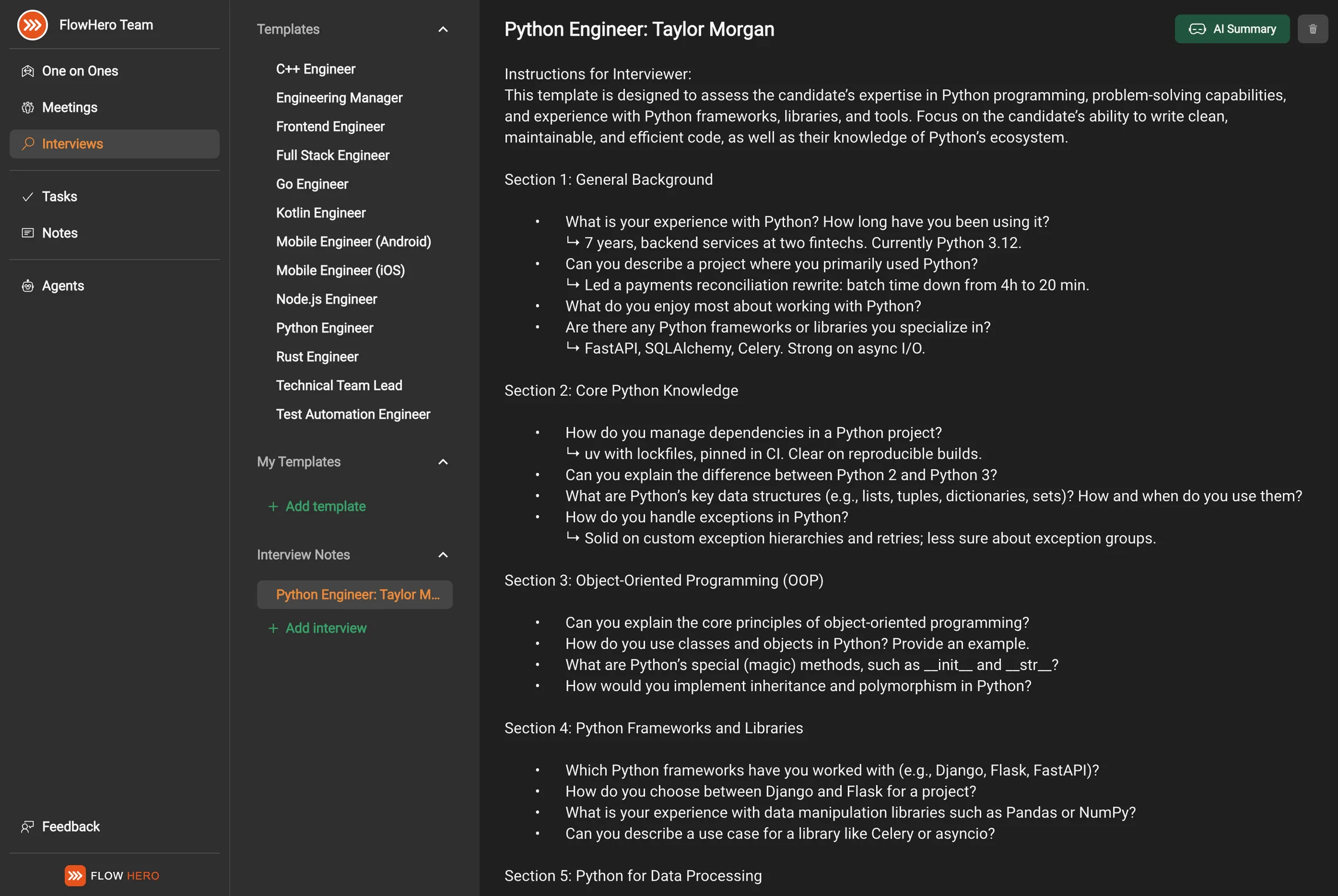
This template is built into FlowHero. Start an interview from it, take notes under each question while you talk, and get an AI summary of your notes to review before the debrief. Start free. No credit card required.
Questions about this template
Live coding or a take-home for Android candidates?
Building an app takes longer than an hour. Either scope the live exercise down to one screen with fake data, or use a short take-home (two or three hours at most) and review it together in the interview.
Should I still ask about XML Views and Fragments?
Briefly, yes. Most production apps mix Compose with older Views and Fragments, so candidates need to work with both.
Does this template cover Kotlin Multiplatform?
Only lightly. For roles built around shared Kotlin code, combine it with the Kotlin engineer template.