How to run it in 60 minutes
- 0–5 minIntroductions, the role and how the interview will run
- 5–15 minBackground and language fundamentals (sections 1–2)
- 15–40 minCoding exercise with follow-ups (section 9)
- 40–52 minCoroutines (section 4) plus either Android (5) or backend (6)
- 52–60 minCandidate's questions (section 12); write up your scores right after
The questions
01General background
- How long have you been working with Kotlin?
- What types of projects have you built using Kotlin?
- Why did you choose Kotlin over other languages for these projects?
- What do you like most about Kotlin?
What to listen for
Android, backend or multiplatform: this decides which of sections 5 and 6 to use. Why Kotlin, and what they'd miss going back to Java.
02Language fundamentals
- What are some key differences between Kotlin and Java?
- Can you explain how Kotlin handles null safety?
- What is the purpose of data classes in Kotlin?
- How do you use extension functions in Kotlin?
What to listen for
Null safety through the type system (?, ?., ?: and avoiding !!). Data classes for value objects with equals, hashCode and copy. Extension functions for readability without inheritance. Awareness of platform types when calling Java.
03Object-oriented and functional programming
- How does Kotlin support object-oriented programming?
- Can you explain how Kotlin supports functional programming concepts like lambdas and higher-order functions?
- What is the difference between sealed classes and abstract classes in Kotlin?
- How do you use Kotlin’s inline functions, and when would you choose to use them?
What to listen for
Sealed classes for closed hierarchies with exhaustive when expressions. Inline functions to avoid lambda allocations and to allow reified type parameters. Idiomatic collection functions instead of manual loops.
04Concurrency and coroutines
- What are coroutines in Kotlin, and how do they differ from traditional threading?
- Can you explain the difference between launch and async in coroutines?
- How do you handle error propagation in coroutines?
- What is your experience with structured concurrency in Kotlin?
What to listen for
launch returns a Job for fire-and-forget work; async returns a Deferred result. Structured concurrency: scopes, cancellation that propagates, SupervisorJob. Choosing dispatchers, handling exceptions, and Flow for streams.
05Kotlin for Android development
Optional: skip this section if the role doesn't involve Android.
- How does Kotlin improve Android development compared to Java?
- What is your experience with Jetpack Compose and Kotlin?
- How do you manage lifecycle-aware components with Kotlin and Android?
- Have you used Kotlin Multiplatform (formerly KMM) to share code between Android and iOS?
What to listen for
Compose state hoisting and recomposition, ViewModels with lifecycle-aware collection, and Kotlin Multiplatform for sharing business logic rather than UI.
06Backend development with Kotlin
Optional: skip this section if the role doesn't involve backend work.
- What is your experience with Kotlin for backend development (e.g., using Ktor, Spring Boot)?
- How do you structure a REST API in Kotlin?
- How do you manage dependency injection in Kotlin?
- What is your experience with Kotlin’s integration with database libraries like Exposed or Hibernate?
What to listen for
Ktor vs Spring Boot trade-offs, dependency injection (Spring, Koin or manual), Exposed or JPA, and coroutines on the server.
07Advanced features
- How do you use Kotlin’s delegated properties?
- Can you explain Kotlin’s value classes (formerly inline classes) and their use cases?
- What is your understanding of typealias in Kotlin?
- How do you use operator overloading in Kotlin, and what are the trade-offs?
What to listen for
Delegated properties (lazy, observable), value classes for type-safe wrappers without allocation, typealias as a naming tool only, operator overloading used sparingly.
08Testing and debugging
- How do you write unit tests in Kotlin?
- What testing libraries do you prefer for Kotlin (e.g., JUnit, MockK, Kotest)?
- How do you handle asynchronous testing in Kotlin?
- Can you explain how you debug Kotlin applications?
What to listen for
JUnit 5 or Kotest, MockK, and kotlinx-coroutines-test with runTest and virtual time; Turbine for testing flows.
09Problem-solving exercise
Give one practical problem and let the candidate talk through it while they code.
Coding challenge (pick one)
- Write a function that takes a list of integers and returns the top three largest values using Kotlin’s features.
- Build a simple REST API in Kotlin using Ktor or Spring Boot.
- Implement a coroutine-based solution to process a list of tasks concurrently.
Follow-up questions
- How did you decide on your approach?
- How would you optimize your solution if performance becomes an issue?
- How would you test your implementation?
What to listen for
Idiomatic code (e.g. sortedDescending().take(3), then a discussion of O(n log n) vs a single O(n) pass), coroutines with bounded concurrency, errors handled rather than swallowed.
10Kotlin ecosystem and tools
- What tools and libraries from the Kotlin ecosystem have you used?
- Have you worked with Kotlin DSLs (Domain-Specific Languages), such as Gradle Kotlin DSL?
- What’s your experience with Kotlin Multiplatform, and how do you approach shared codebases?
- Have you contributed to any Kotlin open-source projects or created custom libraries?
What to listen for
Gradle Kotlin DSL and version catalogs, and real multiplatform experience if they claim it.
11Collaboration and code management
- How do you ensure your Kotlin code is maintainable and idiomatic?
- What is your experience with code reviews and feedback in Kotlin projects?
- How do you manage version control in Kotlin-based projects?
- What’s your approach to documenting Kotlin code and APIs?
What to listen for
ktlint or detekt in CI, KDoc for public APIs, reviews that push toward idiomatic Kotlin.
12Closing questions
- What’s your favorite feature in Kotlin, and why?
- How do you stay updated on Kotlin’s latest features and ecosystem updates?
- Do you have any questions about the role or the Kotlin-related projects you’d be working on?
What to listen for
Curiosity about the language's direction and their own questions about the team's codebase.
Scorecard
Rate each competency from 1 to 4 straight after the interview, before you compare notes with other interviewers, and write down the evidence behind every score.
| Competency | What to assess | Score |
|---|---|---|
| Language fundamentals | null safety, data classes, Java interop | 1–4 |
| Idiomatic Kotlin | sealed classes, extensions, functional style | 1–4 |
| Coroutines | structured concurrency, cancellation, Flow | 1–4 |
| Platform | Android or backend, depending on the role | 1–4 |
| Testing | unit tests, coroutine tests, mocking | 1–4 |
| Problem solving | coding exercise: approach, correctness, edge cases | 1–4 |
| Collaboration | readability, code review, communication | 1–4 |
- 1 · No evidence
- Couldn't answer, or the answer was wrong.
- 2 · Partial
- Knows the concept, but couldn't apply it or needed heavy prompting.
- 3 · Solid
- Correct and applied it to a real example, with minor gaps.
- 4 · Strong
- Clear, correct, discussed trade-offs and went beyond the question.
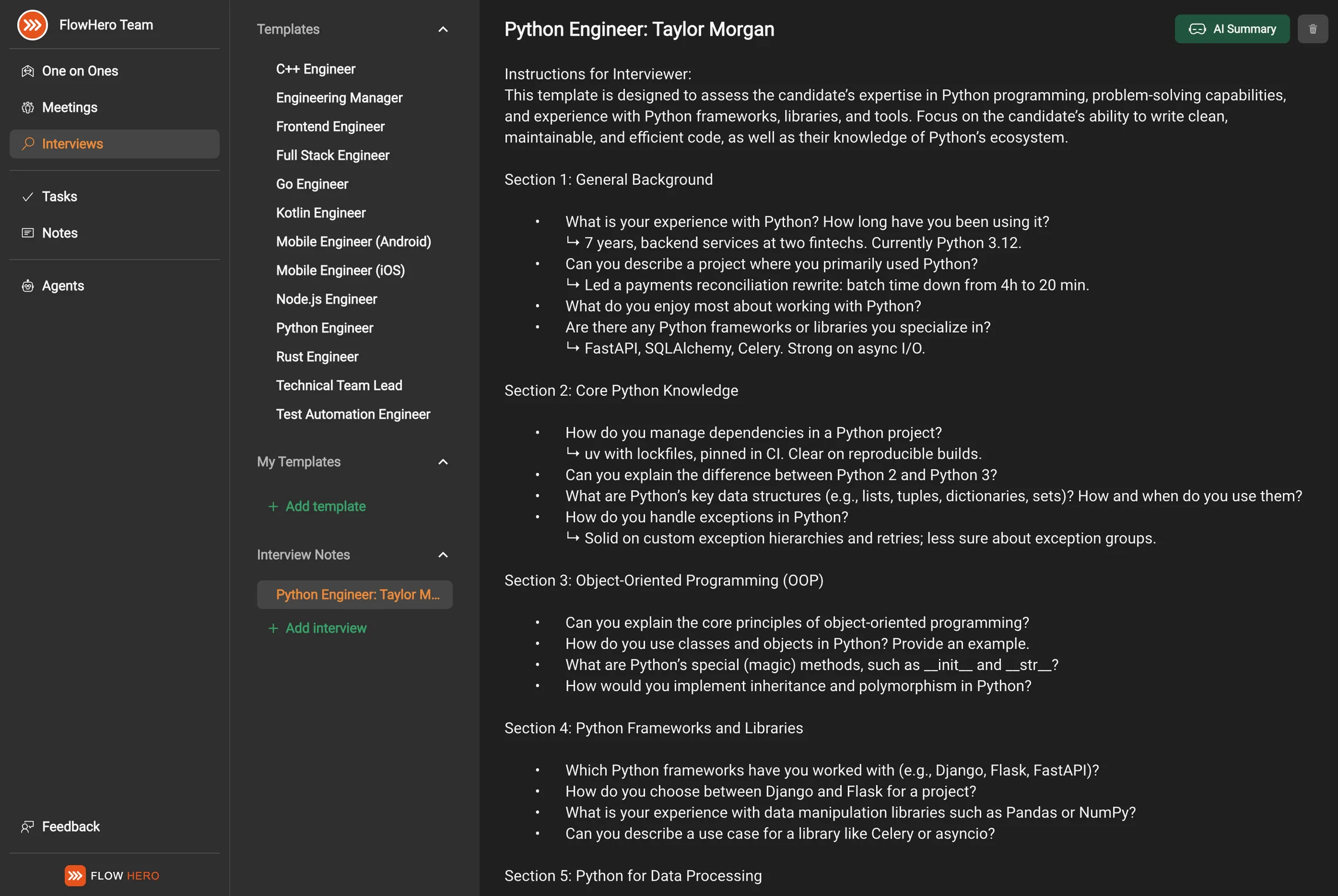
Run this interview in FlowHero
This template is built into FlowHero. Start an interview from it, take notes under each question while you talk, and get an AI summary of your notes to review before the debrief. Start free. No credit card required.
Questions about this template
Is this template for Android or backend Kotlin roles?
Both. Sections 5 (Android) and 6 (backend) are alternatives: use the one that matches the role and skip the other. Everything else applies to any Kotlin engineer.
How do I tell idiomatic Kotlin from Java written in Kotlin?
Look for nullable types used deliberately, data and sealed classes, expressions instead of statements, and scope functions used without overdoing it. Lots of !!, Java-style getters and mutable state everywhere are warning signs.
Should I test Java knowledge too?
On the JVM and Android, interop matters, so ask a question or two. It doesn't need its own section unless the codebase is mostly Java.