How to run it in 60 minutes
- 0–5 minIntroductions, the role and how the interview will run
- 5–15 minBackground and Swift (section 1 and the start of 2)
- 15–40 minApp exercise, scoped to one screen (section 3)
- 40–52 minUI, networking and performance (the rest of section 2)
- 52–60 minCandidate's questions (section 7); write up your scores right after
The questions
01General background
- Tell me about your experience as an iOS developer. What types of apps have you built?
- What programming languages and tools do you commonly use for iOS development?
- Can you describe a challenging project you worked on? What was the challenge, and how did you resolve it?
- Have you published any apps to the App Store? If so, can you walk us through the process?
What to listen for
Apps they shipped, at what scale, and their part in them. Experience with App Store review and releases.
02Technical skills
Swift and Objective-C
- What are the key differences between Swift and Objective-C? When would you choose one over the other?
- Can you explain Swift’s protocol-oriented programming and how it differs from object-oriented programming?
- How do you handle memory management in iOS apps?
UIKit and SwiftUI
- Have you worked with both UIKit and SwiftUI? Which do you prefer, and why?
- Can you describe how you would implement a complex UI layout with either SwiftUI or UIKit?
- How do you handle animations in iOS apps?
Networking and APIs
- How do you handle API calls in your apps? Do you prefer URLSession, third-party libraries, or another approach?
- Can you explain how you would handle offline capabilities in an app?
- How would you structure your code to support RESTful API integration?
Performance optimization
- What strategies do you use to optimize app performance?
- How do you monitor and debug memory issues in your apps?
- Can you share an example of how you improved an app’s responsiveness or loading time?
What to listen for
Swift by default, Objective-C for legacy interop. Value types and protocols with default implementations. ARC, retain cycles and [weak self] in closures. SwiftUI for new screens, UIKit where it's still the better tool. URLSession with async/await and Codable, a local cache for offline. Instruments (Time Profiler, Allocations, Leaks) for performance.
03Problem-solving exercise
Give one realistic problem, scoped down to fit the time, and let the candidate talk through it while they build.
Coding challenge (pick one)
- Implement a simple to-do list app with SwiftUI. The app should allow users to add, delete, and edit tasks.
- Fetch data from a sample API and display it in a list (UITableView or a SwiftUI List). Include pull to refresh.
Follow-up questions
- How would you test your implementation?
- What would you do to make this implementation scalable?
What to listen for
Scope it to one screen. Look for clear state handling, a list with stable identifiers, .refreshable or a refresh control, loading and error states, and testable view models (XCTest or Swift Testing).
04App Store and deployment
- Can you walk me through the process of deploying an app to the App Store?
- How do you handle app versioning and updates?
- Have you integrated in-app purchases or subscriptions in an iOS app? If yes, can you describe the process?
What to listen for
TestFlight, phased releases, App Store review, versioning, and StoreKit 2 for purchases and subscriptions.
05Security and privacy
- How do you ensure user data security in your apps?
- Can you explain how to securely store sensitive data, such as tokens or passwords, on iOS?
- How do you handle compliance with Apple’s App Store guidelines and privacy policies?
What to listen for
Secrets in the Keychain, App Transport Security, privacy manifests and App Tracking Transparency, collecting only the data the app needs.
06Collaboration and teamwork
- How do you collaborate with designers and backend engineers on app development?
- Can you describe a time when you worked with a team to resolve a critical issue in a project?
- How do you ensure code quality and maintainability in a team setting?
What to listen for
Agreeing API contracts with backend early, working from a design system, and shared ownership of quality (reviews, CI, crash reporting).
07Closing questions
- What excites you most about developing for iOS?
- Are there any emerging Apple technologies or frameworks you are particularly interested in?
- Do you have any questions for us about the role or the company?
What to listen for
Interest in Apple's platform direction (Swift concurrency, SwiftUI, new devices) and their own questions about the app.
Scorecard
Rate each competency from 1 to 4 straight after the interview, before you compare notes with other interviewers, and write down the evidence behind every score.
| Competency | What to assess | Score |
|---|---|---|
| Swift | language fundamentals, protocols, value types | 1–4 |
| Memory and concurrency | ARC, retain cycles, async/await | 1–4 |
| UI | SwiftUI and UIKit, layout, animation | 1–4 |
| Networking and data | APIs, Codable, offline | 1–4 |
| Performance | Instruments, responsiveness, launch time | 1–4 |
| Release and security | App Store releases, Keychain, privacy | 1–4 |
| Problem solving | app exercise: structure, states, testing | 1–4 |
| Collaboration | design and backend partnership, quality | 1–4 |
- 1 · No evidence
- Couldn't answer, or the answer was wrong.
- 2 · Partial
- Knows the concept, but couldn't apply it or needed heavy prompting.
- 3 · Solid
- Correct and applied it to a real example, with minor gaps.
- 4 · Strong
- Clear, correct, discussed trade-offs and went beyond the question.
Run this interview in FlowHero
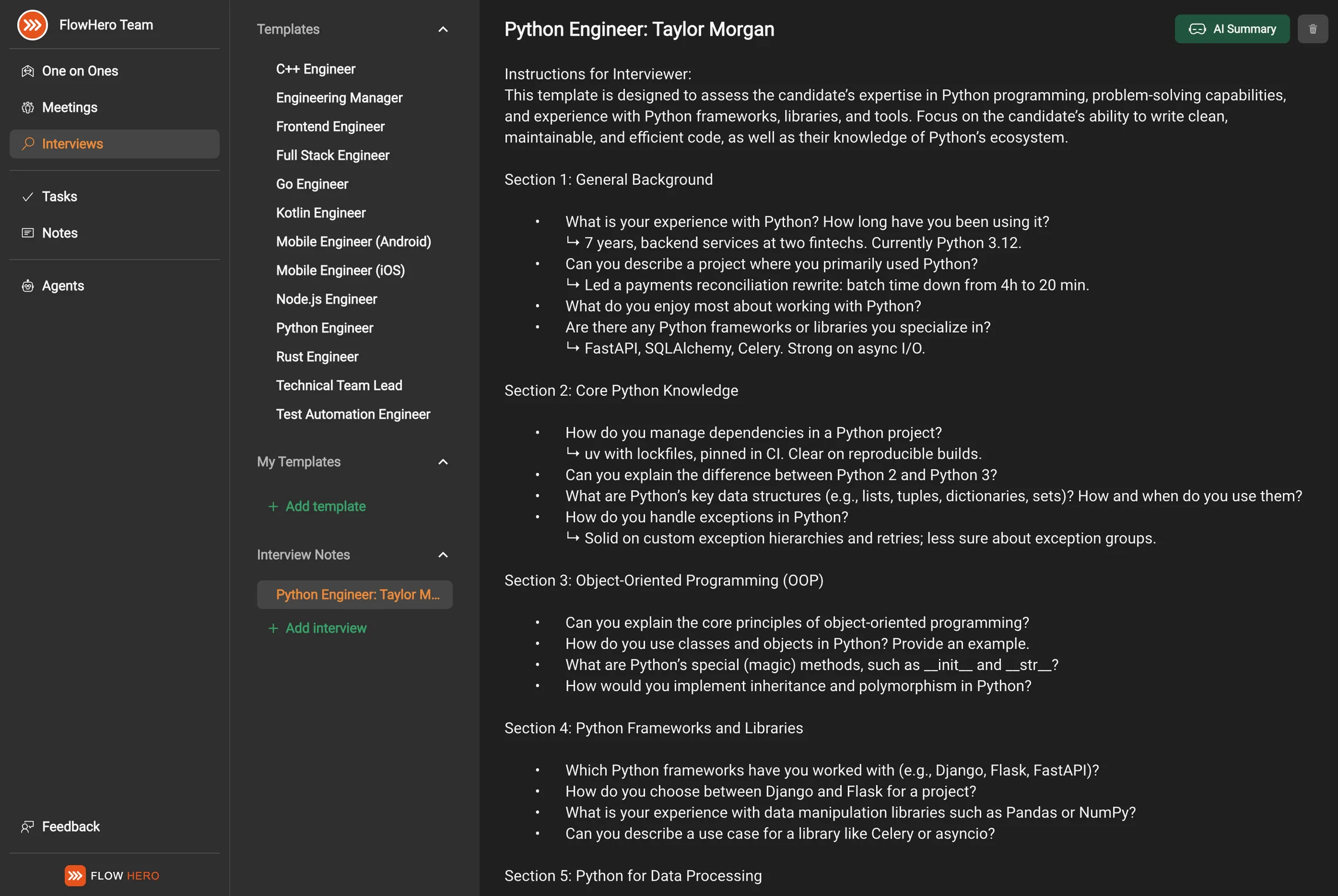
This template is built into FlowHero. Start an interview from it, take notes under each question while you talk, and get an AI summary of your notes to review before the debrief. Start free. No credit card required.
Questions about this template
SwiftUI or UIKit for the exercise?
Let the candidate choose, then ask how they'd build the same screen with the other. Most production apps still mix the two.
What separates senior iOS candidates?
Architecture at scale (modules, dependency injection), Swift concurrency done safely (actors, Sendable), performance work with Instruments, and owning releases end to end.
Should I ask about Objective-C?
Only if your codebase has a meaningful amount of it. Otherwise a single interop question is enough.